If your service desk resolves the exact same VPN timeout ticket forty times a week by telling users to restart their client, your team is not delivering support—they are running an expensive manual treadmill.
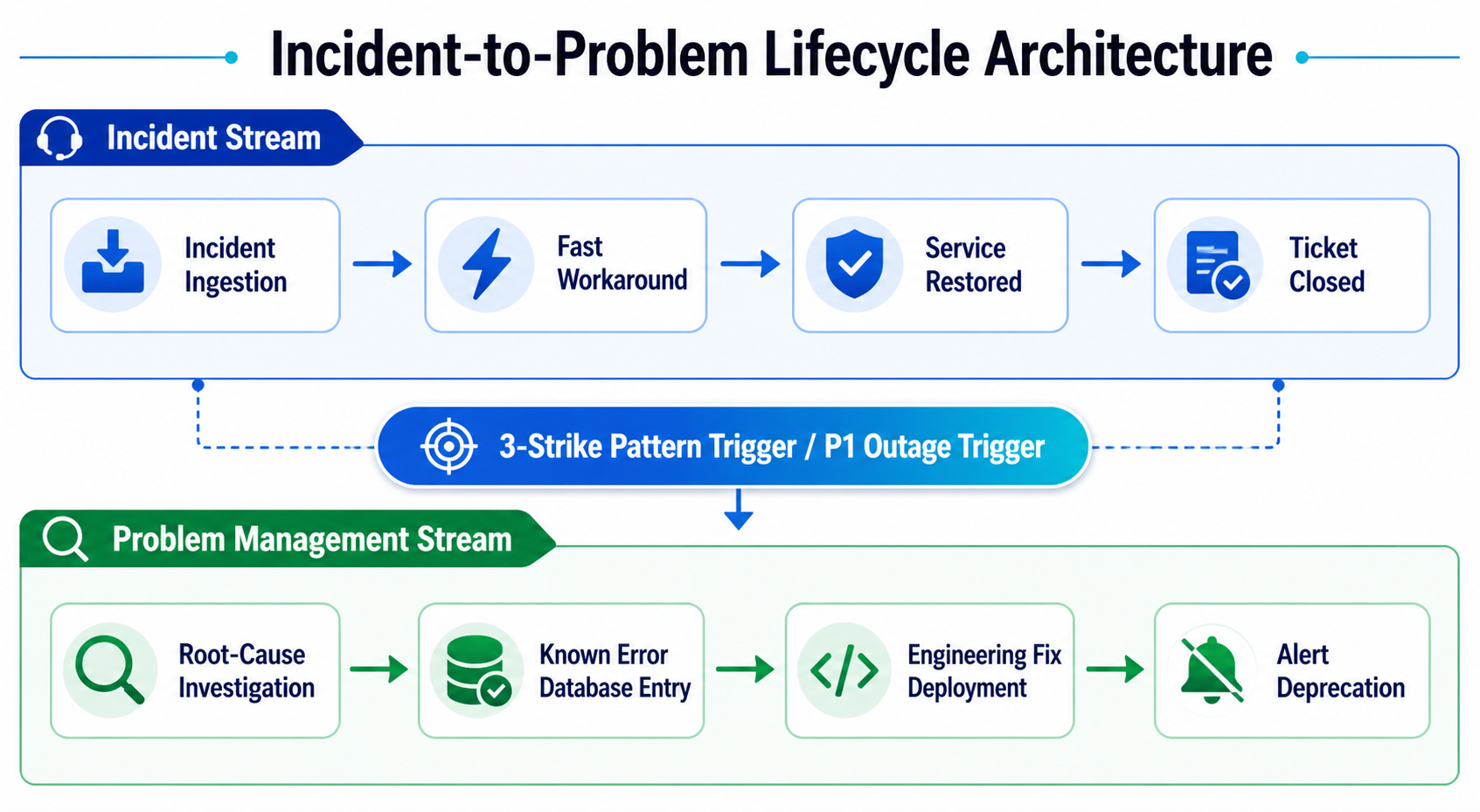
Incident Management is designed for speed: restore service immediately via workarounds. Problem Management is designed for permanence: investigate the root cause, eliminate the underlying defect, and ensure the incident never recurs. Without protected Problem Management capacity, an operations team remains trapped in perpetual reactive churn.
Problem Trigger Threshold
Any incident occurring 3 times across a 30-day window automatically generates a Problem record.
Noise Reduction
Average recurring ticket reduction achieved within 90 days of dedicated RCA implementation.
Known Error Database (KEDB)
Standard workarounds documented for frontline Tier 1 first-touch application.
1. The Incident vs. Problem Separation Architecture
The most common structural mistake in IT operations is assigning Problem Management to the same engineers actively handling the incoming Tier 1/2 ticket queue. Under queue pressure, deep investigation is always abandoned for quick fixes.
| Process Dimension | Incident Management | Problem Management | Primary Operating Difference |
|---|---|---|---|
| Primary Objective | Rapid service restoration via any validated workaround. | Identifying root cause and implementing permanent elimination. | Speed vs. Structural Permanence. |
| Operational Cadence | Real-time, interrupt-driven, high velocity. | Asynchronous, deep investigation, scheduled change windows. | Reactive firefighting vs. Proactive engineering. |
| Success Measurement | Mean Time to Restore (MTTR) & SLA compliance. | Recurring ticket volume reduction & Known Error DB coverage. | Ticket closure count vs. Elimination of ticket causes. |
“Treating an incident with a temporary restart is a loan taken against your future engineering capacity. Problem management is paying off the principal.”
2. The 5-Whys Root-Cause Protocol
Problem investigations must look beyond immediate superficial triggers. The 5-Whys methodology drives past the human symptom down to systemic architecture weaknesses:
- Why 1 (Symptom): The billing application crashed. -> Because the SQL database rejected new connection requests.
- Why 2 (Direct Cause): Why? -> The SQL transaction log disk reached 100% capacity.
- Why 3 (Process Failure): Why? -> The automated nightly log truncation backup job failed.
- Why 4 (Configuration Drift): Why? -> Service account credentials were rotated without updating the backup agent.
- Why 5 (Root Cause / System Fix): Why? -> Lack of centralized Secrets Management with automated credential rotation. Permanent Fix: Deploy Azure Key Vault / CyberArk with automated service principal authentication.
Problem Management Governance Checklist
- Protect 4-8 hours weekly for senior engineers dedicated purely to Problem investigation with zero queue triage duties.
- Maintain a governed Known Error Database (KEDB) embedded directly into your PSA/ITSM ticketing tool.
- Conduct mandatory blameless Problem Reviews for any P1 service outage within 72 hours of restoration.