In a fast-changing world, intelligence is traditionally defined as the ability to think and learn. In *Think Again*, organizational psychologist Adam Grant argues that in complex, volatile environments, true cognitive excellence requires a very different capability: the ability to *rethink* and *unlearn*.
We do not just hesitate to question our beliefs because of cognitive laziness; we avoid rethinking because our beliefs are anchored to our egos and identities. When professionals trap themselves in the cognitive mindsets of Preachers, Prosecutors, or Politicians, they defend outdated assumptions at all costs. Cultivating the mindset of a Scientist enables Confident Humility—the conviction in your capacity to learn paired with the humility to admit what you currently do not know.
Optimal Mental State
Treating opinions as testable hypotheses and actively searching for disconfirming data.
Leadership Balance
Having high faith in your ability to achieve goals while doubting your current methods.
Healthy Disagreement
Fostering vigorous debate on technical ideas while eliminating toxic relationship conflict.
1. The Four Mental Modes of Professional Thinking
| Cognitive Mode | Primary Mindset | Response to Disconfirming Evidence | Professional Consequence |
|---|---|---|---|
| The Preacher | Defends sacred beliefs and attempts to convert others to their dogma. | Rejects evidence as heresy; moralizes own opinion. | Clings to obsolete business models and outdated tech stacks. |
| The Prosecutor | Obsessed with proving the other person wrong and winning the debate. | Attacks flaws in opponent's logic while ignoring weaknesses in own stance. | Destroys psychological safety and alienates engineering peers. |
| The Politician | Campaigns for approval; adopts whichever view pleases the current audience. | Shifts opinions based on social consensus rather than objective data. | Produces spineless leadership that changes direction with every meeting. |
| The Scientist (Optimal) | Treats ideas as hypotheses; seeks truth through experimentation. | Welcomes disconfirming data as an opportunity to update the mental model. | Adapts rapidly to reality and makes superior strategic decisions. |
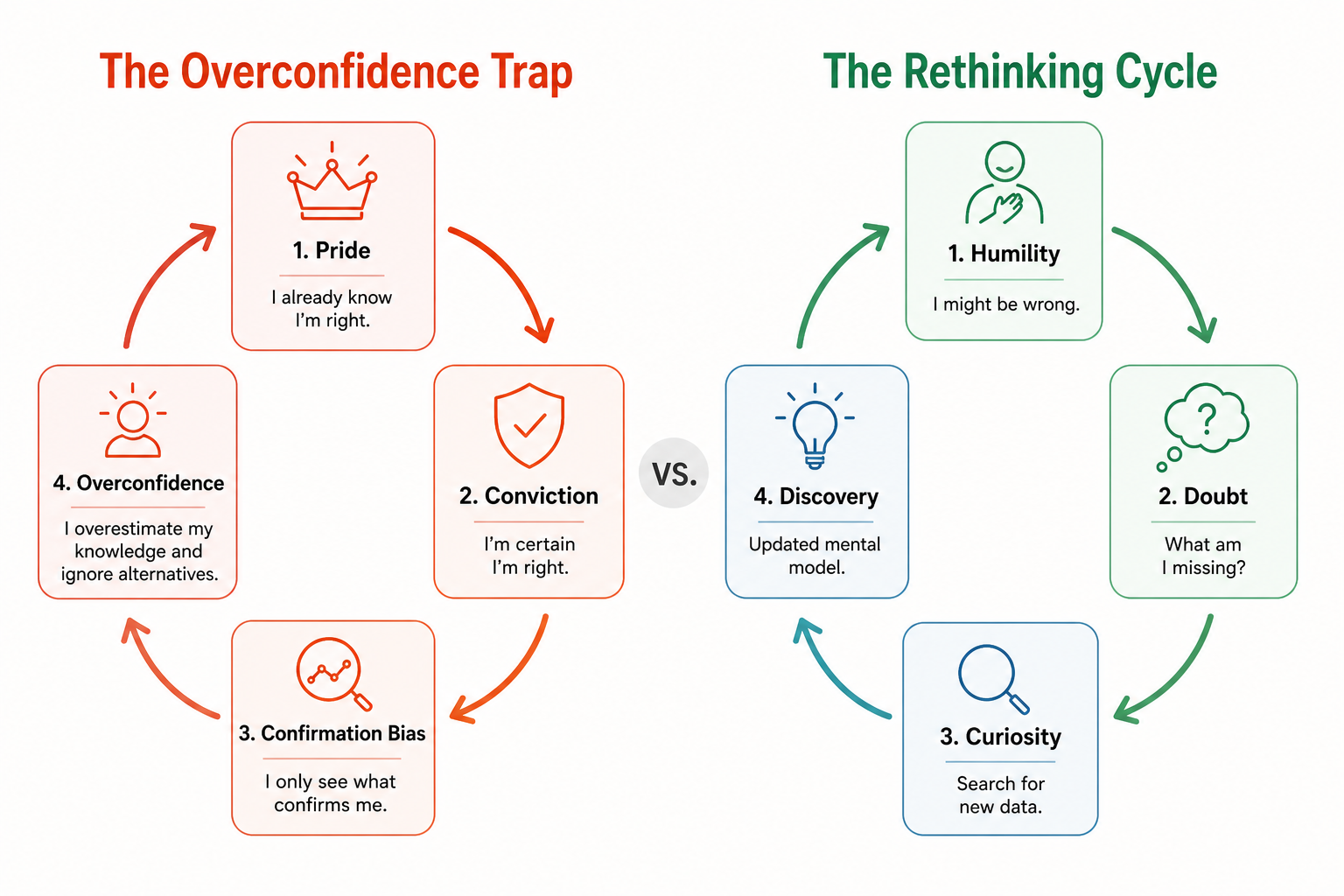
“If knowledge is power, knowing what we don't know is wisdom. The purpose of learning isn't to affirm our beliefs; it is to evolve our beliefs.”
2. What the Book Gets Right About Changing Our Minds
Grant’s most valuable move is separating confidence in ourselves from certainty in our opinions. It is possible to trust our ability to think while admitting that a conclusion may be wrong. That distinction makes revision feel less like humiliation.
The book also understands that disagreement becomes unproductive when it threatens identity. Evidence alone rarely changes a position that has become a badge of belonging. Curiosity creates a different opening: not “How do I defeat this view?” but “What experience makes this view coherent to the person holding it?”
At times the stories resolve more neatly than real disagreement does. Some beliefs survive excellent questions, and some conversations are constrained by status or bad faith. Still, the habit of looking for disconfirming evidence is worth keeping precisely because certainty is so emotionally rewarding.
The question I took away
What evidence would genuinely make me change my mind—and have I designed the answer so that nothing possibly could?