Doing well with money has surprisingly little to do with how smart you are and a lot to do with how you behave. In *The Psychology of Money*, Morgan Housel demystifies personal finance by reframing it from a sterile mathematical exercise into a study of human ego, insecurity, patience, and risk tolerance.
Financial disasters are rarely caused by people failing to understand spreadsheet formulas; they are caused by people over-leveraging to impress strangers, failing to define 'enough', and being forced out of the game during market panics. True wealth is the money you do not spend—it is the unspent optionality that buys autonomy over your time.
Highest Dividend
The ability to wake up every morning and say 'I can do whatever I want today.'
The Hidden Balance Sheet
Status is visible spending; wealth is financial options not yet converted into clutter.
Compounding Imperative
The cornerstone of compounding is never interrupting it unnecessarily.
1. Riches vs. Wealth: The Psychological Spectrum
| Financial Dimension | Being Rich (Visible Status) | Building Wealth (Hidden Autonomy) | Long-Term Psychological Outcome |
|---|---|---|---|
| Primary Motivation | Displaying social status through high-consumption artifacts (cars, luxury). | Purchasing sovereignty over personal time and freedom from external coercion. | Richness is exhausting to maintain; wealth provides quiet internal security. |
| Response to Uncertainty | Panic and forced asset liquidation due to zero cash reserves. | Calm persistence supported by deep liquidity and low fixed expenses. | Survives market drawdowns without interrupting long-term compounding. |
| Defining 'Enough' | Goalposts continuously shift outward as peer income rises. | Explicit ceiling on desires; decoupling personal worth from consumption. | Immune to lifestyle creep and destructive social comparison. |
| Investment Horizon | Seeking maximum short-term returns through leverage and speculation. | Accepting reasonable returns sustained over decades without ruin. | Maximizes probability of long-term financial independence. |
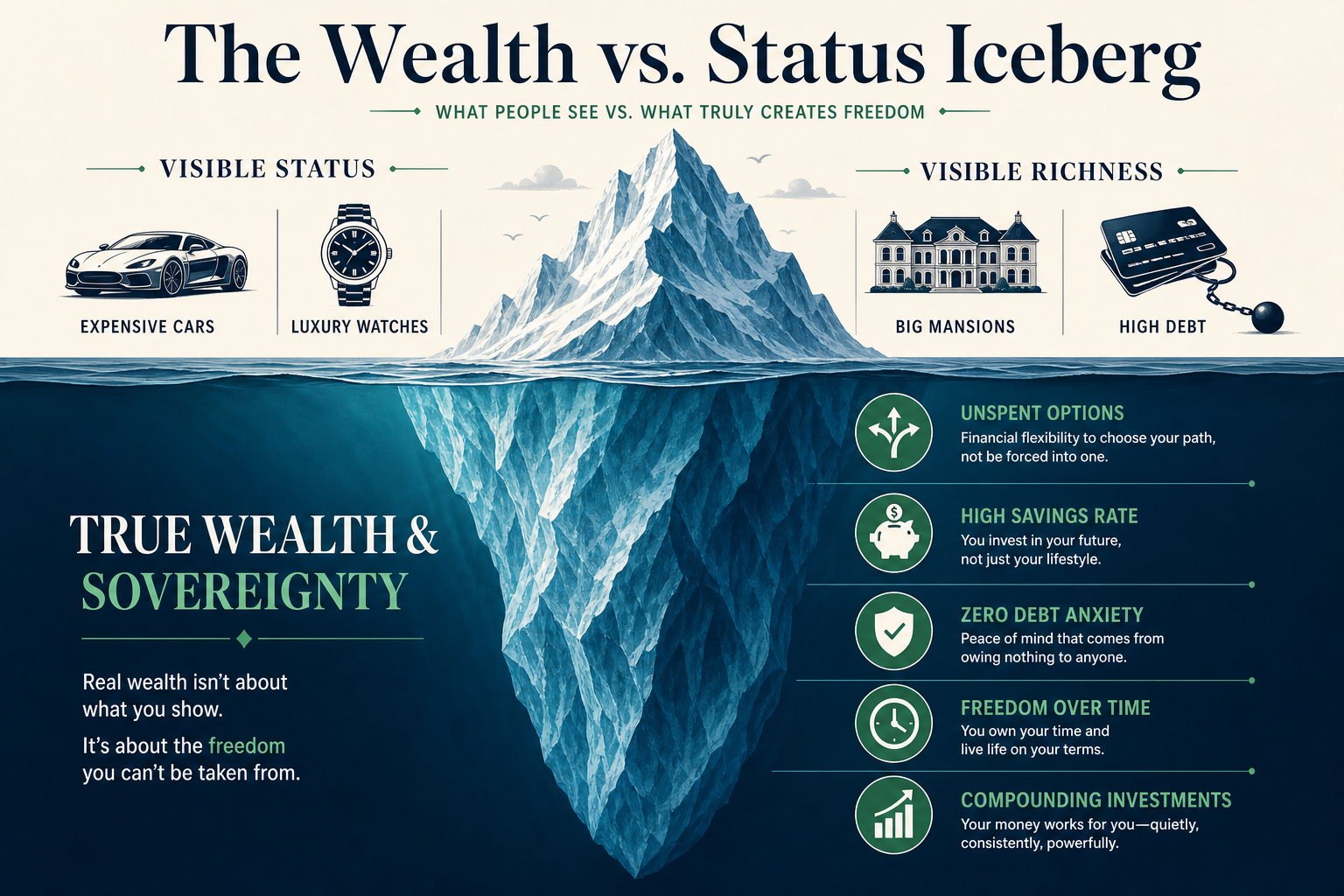
“Spending money to show people how much money you have is the fastest way to have less money.”
2. Core Behavioral Laws of Wealth
- The Power of Compounding: 99% of Warren Buffett's wealth was accumulated after his 50th birthday. The secret is not superior returns, but uninterrupted endurance over seven decades.
- Room for Error: The most important part of every financial plan is planning on your plan not going according to plan. Margin of safety keeps you in the game.
- Reasonable Over Rational: Do not seek an investment strategy that is mathematically optimal on paper if it causes insomnia during a market crash. Choose a strategy that is psychologically comfortable enough to stick with during panics.
- Freedom Is the Goal: The ultimate measure of wealth is not what you own, but whether you control your daily calendar.
Financial Temperament Checklist
- Do you have an explicit financial definition of 'enough' to prevent automatic lifestyle inflation?
- Is your emergency fund sized to survive a multi-year downturn without selling assets at a loss?
- Are your major financial purchases driven by internal utility or external status signaling?