The traditional Network Operations Center (NOC)—a room full of screens where entry-level technicians stare at flashing red dashboard lights and copy-paste alerts into tickets—is completely obsolete.
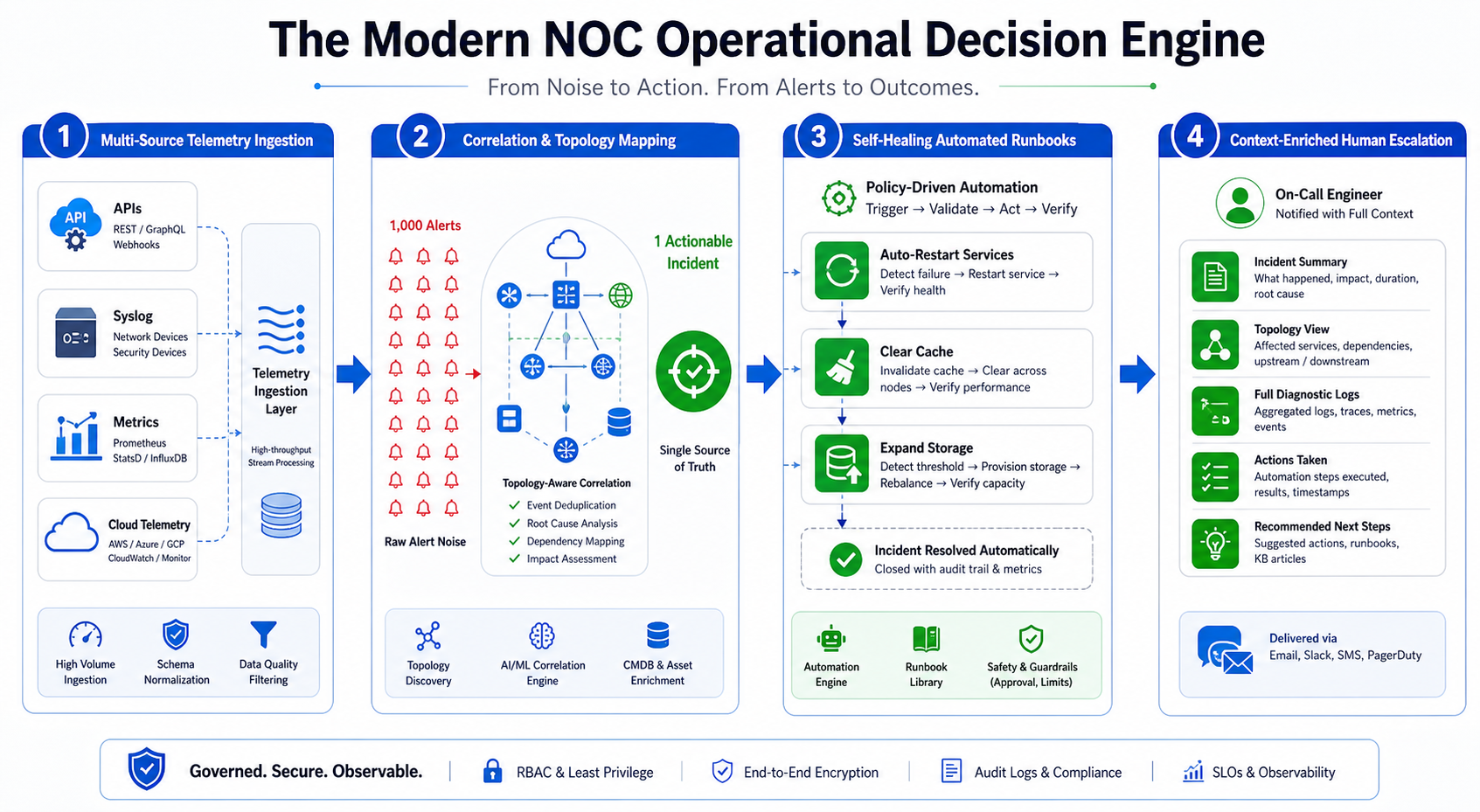
The modern NOC functions as an automated Operational Decision Engine. Instead of manually parsing raw alerts, it ingests multi-source telemetry, correlates isolated events against infrastructure topology, triggers automated self-healing scripts, and escalates to human engineers only when contextual business intervention is required.
Automated Tier 1 Remediation
Proportion of routine telemetry alarms remediated via automated runbooks without human touch.
Event-to-Incident Compression
Raw telemetry event volume consolidated into single correlated incident tickets.
Contextual Enrichment Time
Time required for automation to append topology maps, logs, and client history to escalations.
1. Legacy Alert-Watching vs. Modern Decision Engine NOC
| Operational Capability | Legacy NOC Model (Flawed) | Modern Decision Engine NOC (Advanced) |
|---|---|---|
| Event Ingestion | Disconnected SNMP traps and RMM emails filling an open inbox. | API-driven telemetry ingested into a unified AIOps correlation engine. |
| Alert Triage | Human technician manually reviews every yellow/red alert. | Machine-learning correlation groups alerts by topology and service dependency. |
| Remediation Workflow | Human logs into server via RMM to restart services manually. | Automated webhook executes self-healing runbook within 30 seconds of alert. |
| Escalation Quality | Raw error message forwarded to Tier 3 with no context. | Enriched incident ticket with logs, affected users, and automated diagnostic traces. |
“If a human is required to read an alert and decide which standard script to run, your NOC is simply an expensive, slow translation layer between monitoring and automation.”
2. Implementing the Self-Healing Automation Stack
A decision-engine NOC executes automated remediation across three deterministic tiers before ever paging an on-call engineer:
- Tier 1 (Automated Validation): Check if the alert is transient (re-verify ping/service state after 60 seconds).
- Tier 2 (Safe Self-Healing Action): Execute signed, idempotent runbook (restart spooler/IIS, flush DNS, clear temp disk space).
- Tier 3 (Context Enrichment & Escalation): If self-healing fails, gather last 50 error log entries, capture top 5 CPU processes, attach infrastructure dependency map, and route directly to the designated escalation engineer.
Modern NOC Transformation Checklist
- Deprecate email-to-ticket alerting; mandate webhook-based JSON API ingestion.
- Build automated runbooks for the top 5 most frequent alert triggers across your infrastructure.
- Require all escalation tickets to include automated pre-diagnostic telemetry attachments.