Treating hybrid cloud as merely a collection of data centers connected to public cloud infrastructure via VPN is the fastest route to unmanageable operational friction and runaway egress costs.
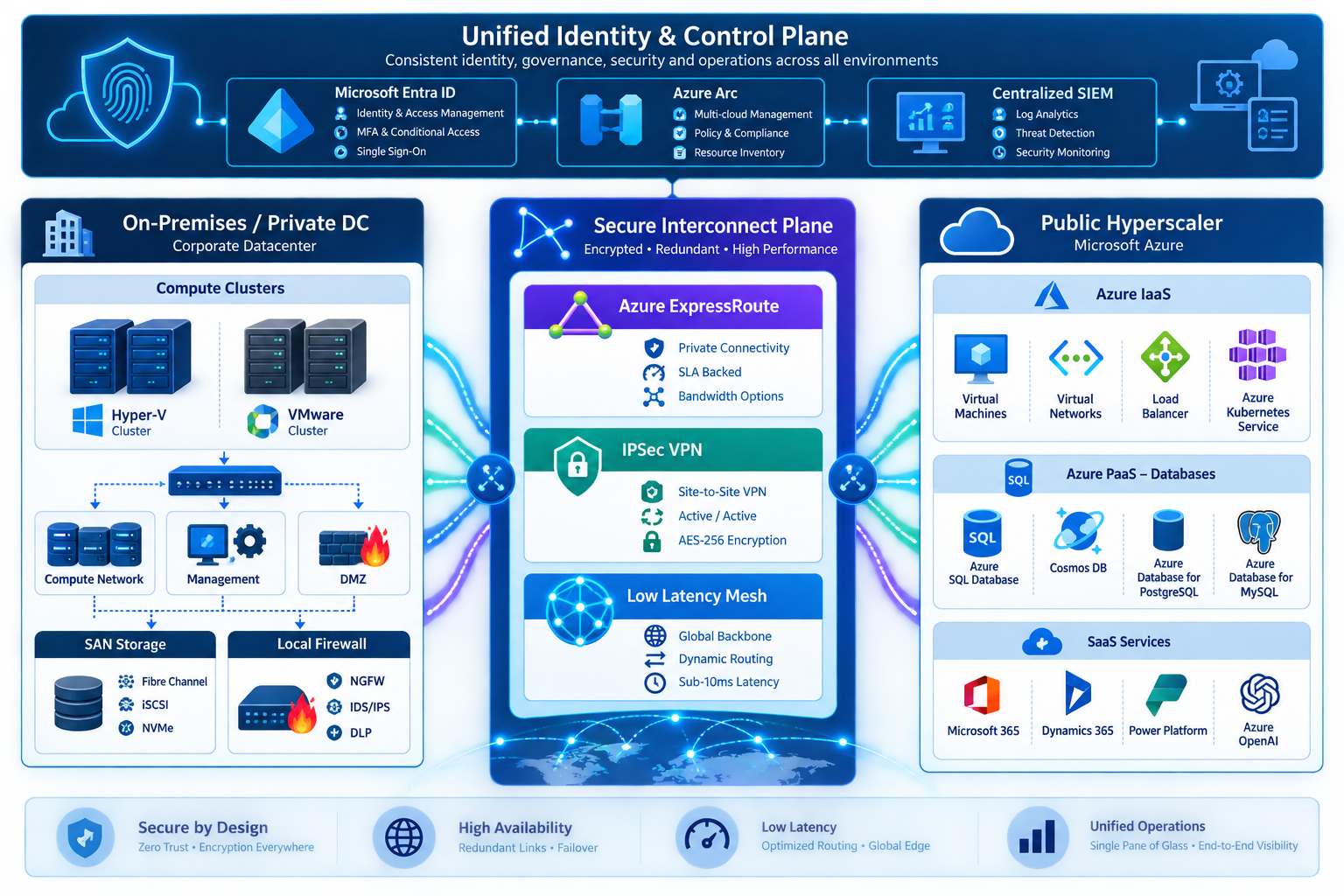
Hybrid cloud is fundamentally an operating-model decision, not a hosting arrangement. The success of a hybrid estate depends on deliberate choices around workload placement, unified identity control planes, integration latency constraints, regulatory data boundaries, and long-term FinOps governance.
Latency Threshold
Maximum acceptable round-trip time for hybrid application-to-database dependencies.
Identity Federation
Single identity control plane (Entra ID) governing on-premises and multi-cloud access.
Average FinOps Waste
Unmanaged cloud spending eliminated via automated right-sizing and reservation governance.
1. The Workload Placement Decision Matrix
Placing workloads across on-premises hypervisors, private colocation, and public hyperscalers requires evaluating structural data constraints rather than following generic cloud-first dogmas:
| Workload Profile | Optimal Placement | Core Technical Rationale | Primary Architecture Trap |
|---|---|---|---|
| High-I/O Transactional Database | On-Premises / Dedicated Colocation | Predictable compute pricing and microsecond-level storage latency. | Excessive cloud egress and IOPS provisioning surcharges. |
| Elastic Web & Customer Portals | Public Hyperscaler (Azure/AWS) | Auto-scaling capability, global CDN presence, and managed PaaS services. | Over-provisioned static VM instances running 24/7. |
| Regulated Data & Local File Shares | Hybrid Azure Arc / Local SAN | Strict regulatory data residency and local gigabit LAN performance. | Poorly configured synchronization agents causing sync conflicts. |
“Cloud migration is not an all-or-nothing binary event; it is a permanent portfolio management discipline where workloads reside wherever performance, compliance, and unit economics align.”
2. The Five Non-Negotiable Hybrid Architectural Pillars
- Unified Identity as the Control Plane: Synchronizing Active Directory to Entra ID with Pass-Through Authentication or Password Hash Sync, enforcing unified Conditional Access everywhere.
- Egress & Latency Engineering: Mapping data dependencies before migration to ensure cloud-hosted applications do not chatter across high-latency WAN links to on-prem databases.
- Centralized Telemetry & Observability: Ingesting logs from on-prem hypervisors, cloud tenants, and firewalls into a single centralized analytics engine (Sentinel/Azure Monitor).
- Immutable Cross-Environment BCDR: Ensuring backup snapshots are air-gapped and stored across isolated cloud regions regardless of where the primary workload executes.
- Proactive FinOps Governance: Automating instance scheduling, tagging every resource by cost center, and executing quarterly reservation optimizations.
Hybrid Cloud Execution Checklist
- Conduct an application dependency mapping audit before moving any multi-tier workload to public cloud.
- Enforce Azure Arc or unified policy agents across all on-premises servers for centralized patch governance.
- Establish automated cost anomaly alerts to capture egress spikes and unattached storage volumes.