Most interpersonal anxiety, professional burnout, and relational conflict originate from a single cognitive failure: living your life to satisfy the expectations of other people. In *The Courage to Be Disliked*, Ichiro Kishimi and Fumitake Koga translate nineteenth-century Adlerian psychology into a modern dialogue, dismantling the comforting excuses that keep individuals trapped in emotional dependency.
Alfred Adler’s framework departs radically from Freudian determinism. While Freud argues that our present is irrevocably shaped by past trauma (etiology), Adler asserts that we choose our present behavior to serve current goals (teleology). True psychological freedom is not the absence of social friction; it is the deliberate courage to define your own responsibilities, decline other people's emotional baggage, and embrace the unavoidable risk of being disliked.
Core Adlerian Anchor
Identifying whose task an issue is by asking 'Who ultimately bears the end result of this choice?'
Purpose Over Past
Behavior is driven by current goals and utility, not trapped by past historical traumas.
Healthy Connection
Shifting from 'What will others give me?' to 'How can I contribute to this community?'
1. Freudian Determinism vs. Adlerian Agency
Understanding Adlerian thought requires examining how it inverts traditional assumptions about trauma, motivation, and interpersonal dynamics:
| Psychological Dimension | Freudian Perspective (Etiology) | Adlerian Stance (Teleology) | Operational Consequence |
|---|---|---|---|
| Source of Current Behavior | Past emotional trauma and unresolved childhood wounds determine present action. | Present actions are chosen to achieve immediate internal goals (e.g., avoiding social risk). | Restores personal agency; eliminates the excuse of victimhood. |
| Interpersonal Friction | Misunderstandings arise from incompatible personalities and external malice. | All interpersonal conflict stems from intruding on other people's tasks or allowing them to intrude on yours. | Provides a clear boundary filter to halt emotional enmeshment. |
| Motivation for Achievement | Striving to win external praise, validation, and social status. | Seeking self-acceptance through contributing value to the community without needing recognition. | Prevents burnout and eliminates chronic approval-seeking. |
| Meaning of Freedom | Freedom is having no constraints, perfect circumstances, and universal love. | Freedom is the willingness to be disliked by others while pursuing your authentic task. | Generates resilient leadership and decisive execution. |
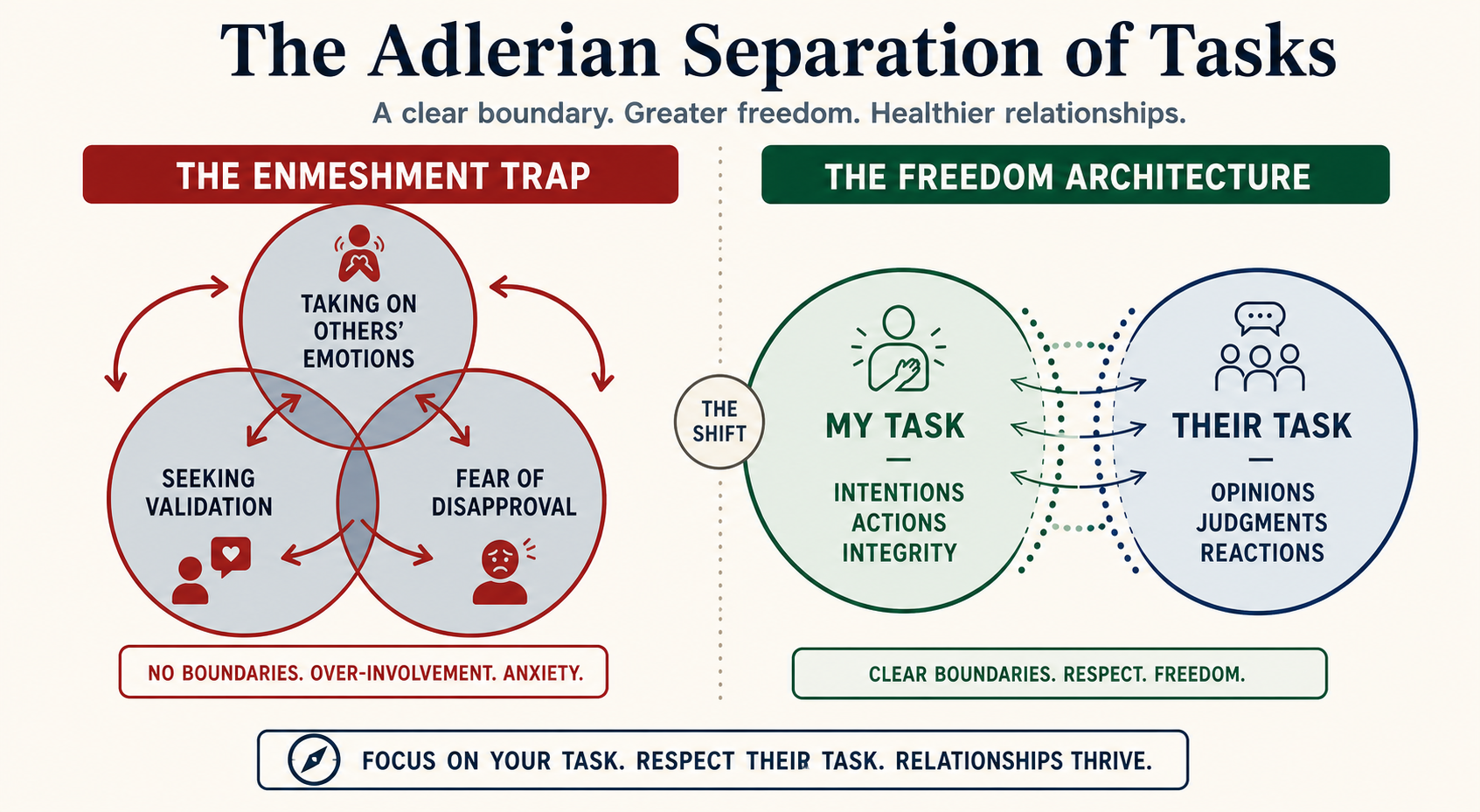
“To be disliked by someone is proof that you are living freely, according to your own principles. You do not live to satisfy other people's expectations, and other people do not live to satisfy yours.”
2. The Architecture of Task Separation
To execute the Separation of Tasks in leadership, engineering, and personal life, apply three operational rules:
- Identify the Task Owner: Determine who directly absorbs the consequences of the decision. That person holds exclusive ownership of the task.
- Refuse Intrusive Rescuing: Do not take on other people's responsibilities, manage their emotional comfort, or shield them from the natural outcomes of their choices.
- Relinquish Approval-Seeking: Recognize that how others evaluate your work, leadership, or character is *their* task, not yours. Your only task is to act with technical and ethical integrity.
Adlerian Freedom Checklist
- Stop asking 'What will they think of me?' and ask 'What is the right engineering or ethical decision here?'
- Decline meetings or requests where your presence serves only to soothe another person's inability to make a decision.
- Accept that doing meaningful, principled work will inevitably disappoint those who preferred your compliance.