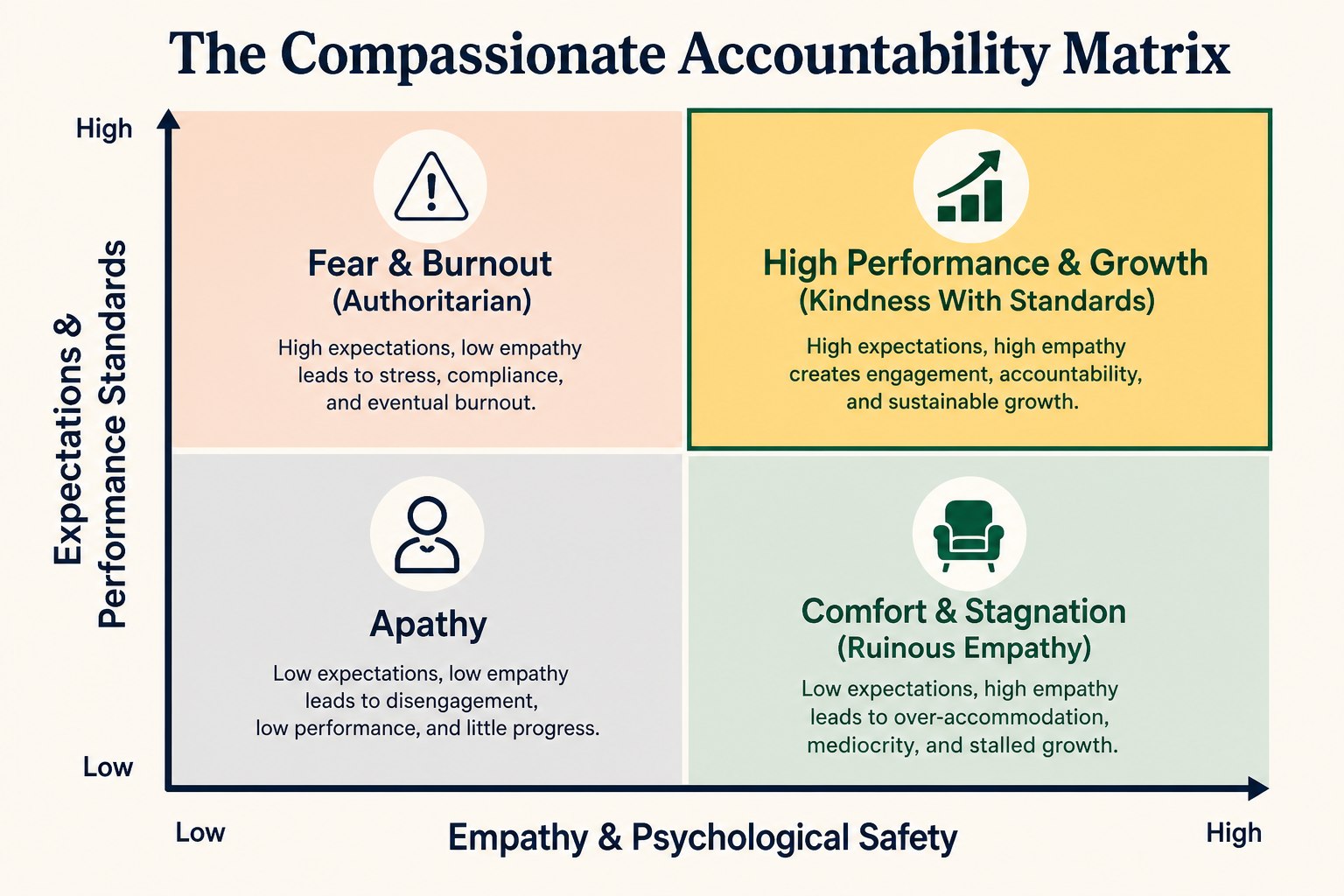
Conventional management theory often presents a false dichotomy: leaders must choose between being a demanding, hard-nosed driver who gets results, or a friendly, approachable manager who sacrifices rigor for likability. *Ted Lasso* obliterates this myth by demonstrating that radical empathy and uncompromising performance standards are not opposing forces—they are mutually reinforcing pillars of high-performing teams.
When Ted Lasso arrives at AFC Richmond, he does not treat psychological safety as a replacement for athletic discipline. Instead, he uses authentic curiosity, vulnerability, and personal care to build the relational trust required to challenge elite athletes to perform at their absolute ceiling. By separating an individual's worth as a person from their tactical performance on the pitch, leaders can enforce rigorous standards without producing defensive, fear-driven cultures.
The Leadership Sweet Spot
Combining deep personal care with the willingness to challenge directly and uncompromisingly.
The Goldfish Metaphor
Rapid psychological recovery from acute errors to prevent shame spirals from degrading future play.
Psychological Safety
Sourcing strategic insights from every organizational tier, from star players to kit managers.
1. Toxic Demands vs. Performative Politeness vs. Empathetic Accountability
Examining different managerial postures reveals why compassionate leadership outperforms both fear-based authoritarianism and passive permissiveness:
| Leadership Dimension | Authoritarian Fear (Rupert / Pre-Ted) | Passive Permissiveness (False Kindness) | Compassionate Rigor (The Lasso Way) |
|---|---|---|---|
| Response to Errors | Public humiliation, scapegoating, and benching driven by anger. | Ignoring substandard performance to avoid interpersonal discomfort. | Immediate tactical correction paired with emotional reaffirmation ('Be a goldfish'). |
| Psychological Safety | Zero safety; players hide injuries, mistakes, and tactical vulnerabilities. | Superficial comfort; zero constructive conflict or honest feedback. | High safety; players admit weaknesses, seek help, and support peer growth. |
| Talent Management | Pandering to toxic star players (e.g., Jamie Tartt) at team expense. | Allowing poor performers to drag down team momentum unchecked. | Benching toxic stars to protect cultural integrity while investing in their redemption. |
| Source of Strategy | Dictated exclusively from top management; frontline input ignored. | Chaotic consensus seeking with zero executive decisiveness. | Democratic ideation (Nate's plays) backed by decisive executive implementation. |
“For me, success isn't about the wins and losses. It's about helping these young fellas be the best versions of themselves on and off the field. It ain't always easy, but neither is growing up.”
2. Kindness Is Not the Entire Story
Ted’s warmth changes AFC Richmond because it allows people to become less defended. Rebecca can move from revenge toward repair. Jamie’s performance stops being inseparable from cruelty. Roy discovers that care does not weaken authority. Nate’s arc shows the opposite movement: recognition cannot heal a wound that has become organised around resentment.
The series is also honest, especially later, that optimism can become avoidance. Ted is skilled at making other people feel safe while struggling to remain present with his own pain. Therapy matters because charm cannot do the work of acknowledgement.
Some conflicts resolve with more grace than real life usually provides, and the final season can feel crowded. Yet the show’s generosity is not the belief that everyone is secretly harmless. It is the belief that accountability and the possibility of change can coexist.
What stayed with me
“Believe” matters less as confidence that everything will work out than as a willingness to keep seeing people as unfinished—including the person doing the believing.