Chief Information Officers, vCIOs, and MSP leaders frequently complain that corporate boards treat technology solely as an unmanageable cost center. Yet when these same leaders present capital requests, they deliver technical project wish-lists: switch replacements, server migrations, SAN upgrades, and licensing renewals devoid of commercial context.
Executive boards and Chief Financial Officers do not fund technical specifications; they fund Risk Reduction, Operational Throughput, and Regulatory Compliance. To secure capital allocation, technology leaders must transform technical tasks into strategic investment roadmaps linked to clear business outcomes.
Planning Horizon
24-to-36 month strategic lifecycle mapping risk, efficiency, and modernization.
TCO Visibility
Full disclosure of CapEx, OpEx, multi-year maintenance, and operational labor.
Board Approval Rate
Average funding rate for roadmaps tied directly to quantifiable operational risks.
1. Translating Technical Debt into Executive Risk
Bridging the communication gap between engineering and the board room requires translating component-level technical tasks into executive investment narratives:
| Technical Project Language (Rejected) | Strategic Business Translation (Approved) | Primary Financial & Risk Driver |
|---|---|---|
| Upgrade core switches and firewalls to latest firmware. | Eliminate single points of failure across supply-chain processing facilities. | Prevents unrecoverable production downtime valued at $45,000/hour. |
| Implement Entra ID P2 with Conditional Access and PIM. | Achieve compliance readiness for Cyber Insurance underwriting renewal. | Protects against policy cancellation and prevents identity breach liabilities. |
| Migrate on-premises file server to SharePoint and Azure Files. | Enable secure remote worker collaboration and eliminate tape backup maintenance. | Reduces real estate footprint and cuts annual hardware warranty costs by 32%. |
“When you present a server upgrade, you invite a line-item budget debate. When you present an investment that protects $10M in annual transactional revenue, you create a capital investment consensus.”
2. The Anatomy of an Executive-Ready Roadmap
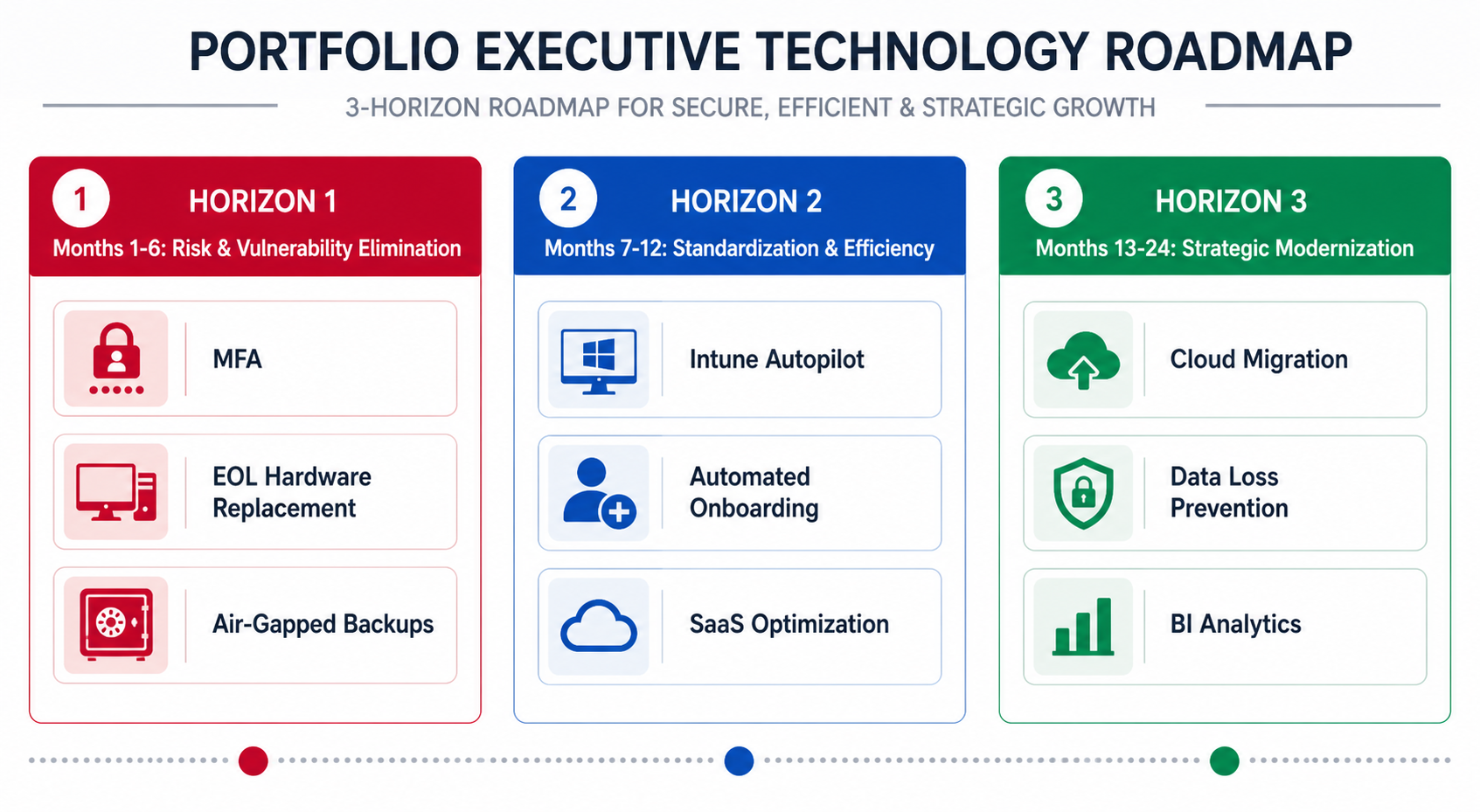
A funded technology roadmap organizes strategic initiatives across a 24-to-36 month horizon, structuring proposals through three distinct decision gates:
- Horizon 1 (Foundation & Risk Elimination): Critical remediation addressing unbacked workloads, unpatched EOL operating systems, and identity vulnerabilities.
- Horizon 2 (Process Standardization & Efficiency): Centralized device management via Intune, automated employee onboarding workflows, and SaaS license rationalization.
- Horizon 3 (Strategic Modernization & Agility): Cloud modernization, legacy ERP data consolidation, and advanced data-loss prevention implementation.
Roadmap Approval Framework
- Quantify the cost of inaction: Clearly articulate the quantifiable operational cost of system failure if the project is deferred.
- Tie every capital expenditure directly to an accountable executive sponsor outside of the IT department.
- Establish transparent milestone gates where funding is released incrementally upon verified technical milestone completion.