Simon Sinek's *Start With Why* is widely celebrated in marketing circles, yet it is often reduced to a superficial branding exercise. Companies craft high-sounding mission statements to splash across slide decks, while their daily operational decisions, compensation models, and support interactions directly contradict those stated values.
True leadership begins from the inside out. Sinek's Golden Circle—Why, How, and What—is not an advertising formula; it is a structural blueprint for organizational integrity. When a company's core purpose (Why), cultural disciplines and technical standards (How), and delivered products or services (What) are aligned, customer loyalty shifts from transactional price-sensitivity to enduring, biological trust.
Structural Hierarchy
Why (Core Purpose) -> How (Guiding Principles) -> What (Tangible Output).
Decision Center
The limbic brain governs gut-level trust and loyalty, while the neocortex rationalizes details.
The Authenticity Test
Trust erodes the moment daily delivery behavior contradicts the stated core mission.
1. The Golden Circle: Transactional Push vs. Purpose-Driven Pull
Most organizations communicate from the outside in—starting with the tangible product and working inward toward unclear motivations:
| Layer | Transactional Communication (Outside-In) | Purpose-Driven Alignment (Inside-Out) | Operational Manifestation |
|---|---|---|---|
| WHAT (The Product/Service) | "We sell managed IT support and cloud migration services." | "We build bulletproof, transparent infrastructure environments." | The tangible deliverable, tickets closed, and contracts signed. |
| HOW (The Values/Process) | "We have 24/7 helpdesks and certified technicians." | "...by enforcing strict golden baselines and eliminating operational noise..." | The operational runbooks, architecture standards, and service discipline. |
| WHY (The Core Belief) | "To generate quarterly revenue and increase gross margins." | "...so our clients' teams can scale their businesses without fear of operational failure." | The foundational conviction that guides pricing, hiring, and trade-offs. |
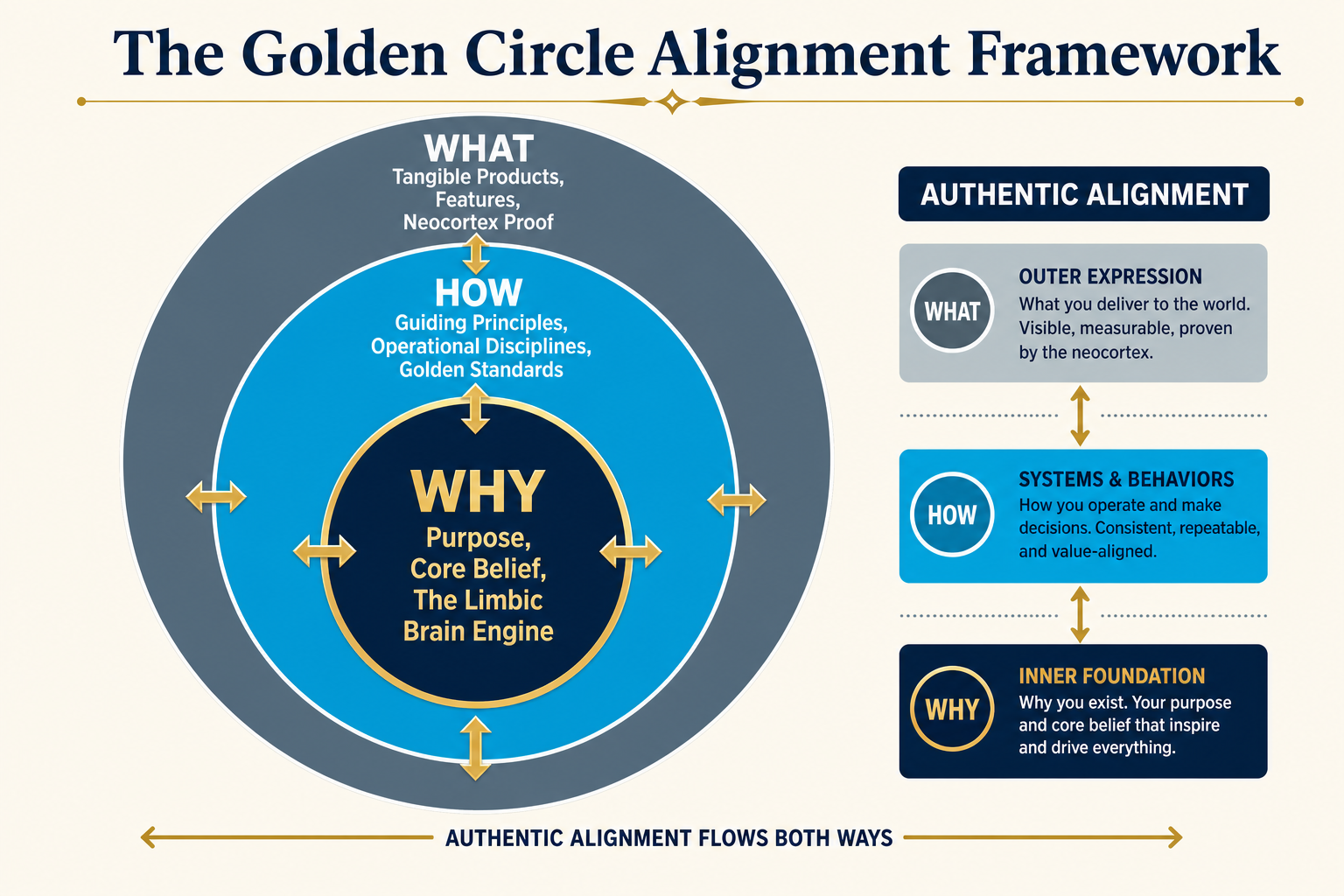
“People don't buy what you do; they buy why you do it. And what you do simply serves as the tangible proof of what you believe.”
2. Why the Idea Travels—and Where the Evidence Feels Thin
The Golden Circle is memorable because it gives language to an experience most people recognise: some organisations and movements feel coherent before we can explain why. Purpose can guide choices, help people recognise belonging, and make communication more than a list of features.
But the model is more persuasive as a communication device than as a settled account of human biology. Its popular explanation of the brain is simplified, and successful organisations do not succeed through purpose alone. Capability, timing, distribution, pricing, luck, and execution still matter. A compelling why cannot rescue a poor experience.
The idea remains useful when it is treated as a test of consistency. If the stated purpose disappears when a difficult trade-off arrives, it was probably a slogan. If it repeatedly shapes what is accepted, refused, built, and repaired, people can feel the difference.
What stayed with me
Purpose is not the sentence placed above the work. It is the pattern a reader, employee, or customer can infer from the choices made when nobody is presenting the slide.