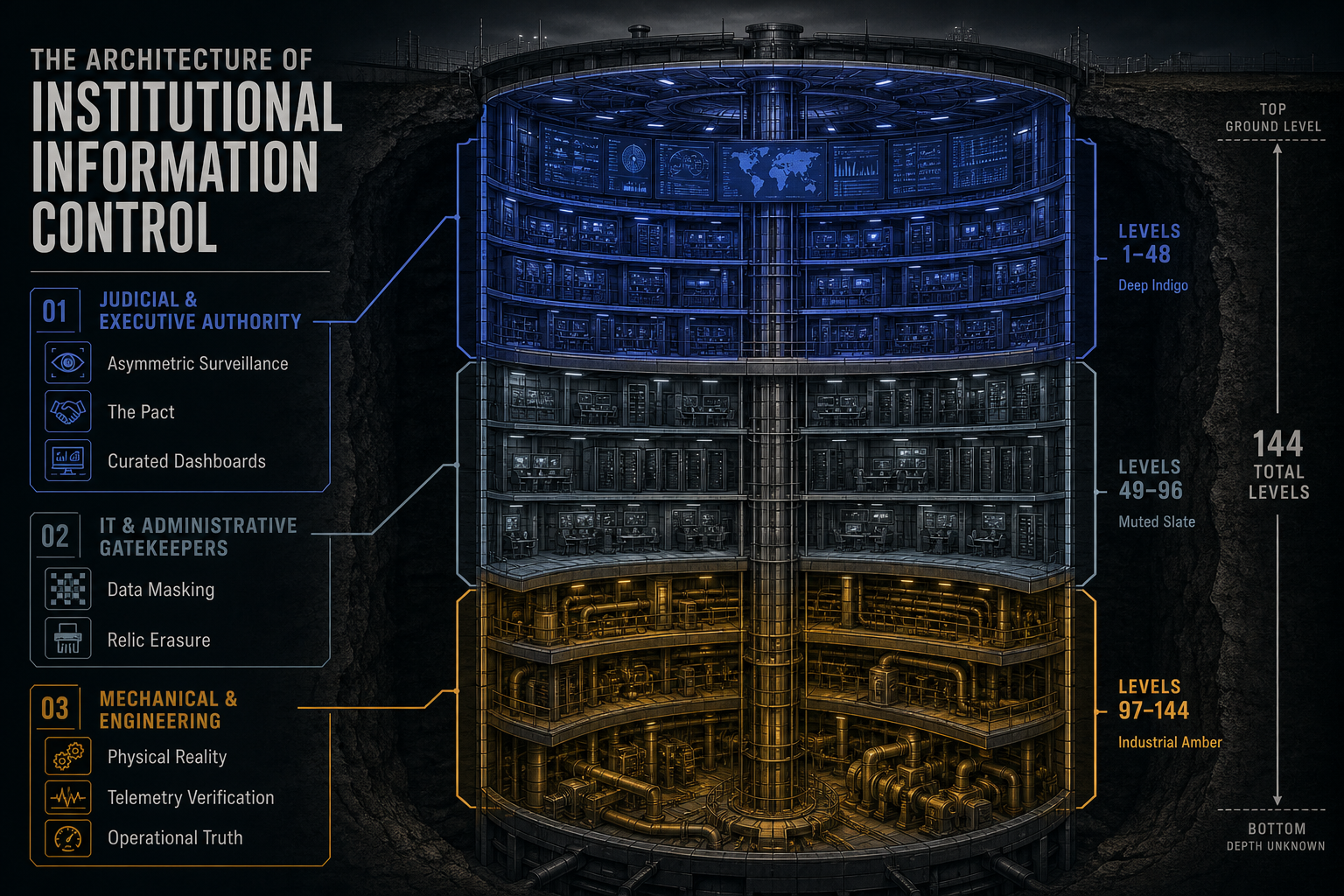
In a massive underground bunker 144 levels deep, ten thousand people survive under the strict dictums of the 'Pact.' In *Silo*, the ruling authorities claim that absolute secrecy, historical erasure, and the swift execution of anyone who expresses curiosity about the outside world are necessary safeguards to preserve human life.
The series serves as a chilling masterclass in the mechanics of authoritarian information governance. When leadership maintains stability through data silos, surveillance optics, and manufactured historical amnesia, it creates an inherently fragile ecosystem. True operational resilience cannot be built on curated falsehoods; the moment frontline practitioners (the mechanics and engineers in the deep down) begin verifying telemetry against reality, the institutional narrative inevitably fractures.
Physical & Data Siloing
Deliberate segmentation of departments and manual transit to prevent inter-tier coordination.
Manufactured Amnesia
Complete erasure of pre-Silo records to eliminate historical benchmarks and alternatives.
Asymmetric Surveillance
Secret monitoring arrays hidden behind everyday mirrors to preserve executive information dominance.
1. Pillars of Institutional Control in Closed Systems
The Silo’s governance model relies on four deliberate architectural levers to suppress inquiry and enforce obedience:
| Control Lever | Silo Operational Mechanism | Modern Organizational Parallel | Long-Term Failure Mode |
|---|---|---|---|
| Historical Erasure | Relics and books banned; history before the Rebellion deleted. | Deleting legacy documentation and obscuring past architectural failures. | Engineers repeat catastrophic historical errors without context. |
| Rigid Data Segmentation | Prohibiting elevators or digital comms; using manual porters. | Isolating operations, development, and executive teams in silos. | Systemic opacity, tribal distrust, and severe operational latency. |
| Performative Transparency | The public cafeteria screen showing a toxic, unlivable wasteland. | Curated dashboard metrics presented to leadership while hiding technical debt. | False confidence leading to catastrophic blind-side failures. |
| Criminalized Inquiry | Saying 'I want to go outside' results in mandatory death. | Labeling constructive dissent or architectural questioning as 'insubordination'. | Flight of top talent and silent accumulation of fatal vulnerabilities. |
“An institution that relies on the suppression of truth to maintain order is not preserving stability—it is simply engineering a delayed, catastrophic explosion.”
2. Whoever Controls Memory Controls Reality
Juliette’s strength is not that she begins with a complete theory. She begins with an unwillingness to ignore inconsistencies. Her mechanical background matters because she trusts systems enough to inspect them, but not enough to confuse official function with truth.
The silo’s deepest control is historical scarcity. People cannot compare the present with an independently remembered past, so rules acquire the force of nature. Relics are dangerous not because each object reveals everything, but because they prove that another account of reality exists.
Bernard is more interesting than a simple villain because he experiences secrecy as responsibility. The series keeps asking whether stability built on managed ignorance can ever be legitimate—and whether revealing truth without understanding its consequences can also become a form of harm.
The tension the series preserves
Truth and trust are not interchangeable. A population denied truth has reason to distrust authority; a truth revealed without context may still leave people unable to act safely.