Most strategic planning fails because it obsesses over forecasting what will change in the next decade—which technologies will dominate, which markets will disrupt, and which trends will peak. In *Same as Ever*, Morgan Housel presents the counterintuitive thesis: real decision-making leverage comes from studying what *never* changes.
While tools, infrastructure, and technology evolve at breakneck speed, human psychology—how people respond to greed, panic, uncertainty, incentives, and social status—remains virtually identical across millennia. By anchoring business strategies, investments, and leadership principles to permanent human behaviors rather than fragile forecasts, leaders build enduring resilience.
Core Behavioral Invariants
Timeless truths governing risk, expectations, patience, and human frailty.
Forecasting Vulnerability
All major historical events were black swans unpredicted by consensus models.
Happiness Equation
Life satisfaction equals reality minus expectations, regardless of absolute wealth.
1. Core Mental Models: Forecasting Change vs. Studying Permanence
| Strategic Domain | Fragile Forecasting (What Might Change) | Permanent Invariants (What Never Changes) | Decision Advantage |
|---|---|---|---|
| Risk Assessment | Building statistical models predicting the next specific crisis. | Accepting that the biggest risk is always the one nobody sees coming. | Preserves cash reserves and builds structural resilience rather than optimized fragility. |
| Customer Demand | Chasing fleeting aesthetic trends and transient marketing buzz. | Focusing on timeless desires: speed, low price, reliability, and status. | Invests in product pillars that will remain valuable twenty years from now. |
| Operational Efficiency | Optimizing systems to 100% utilization to eliminate idle cost. | Building redundant slack into calendars, cash, and capacity to absorb shocks. | Survives unexpected supply disruptions and systemic stress without breaking. |
| Personal Happiness | Believing that achieving a higher wealth milestone creates permanent peace. | Recognizing that lifestyle expectations automatically expand to consume income. | Manages internal expectations rather than running on the hedonic treadmill. |
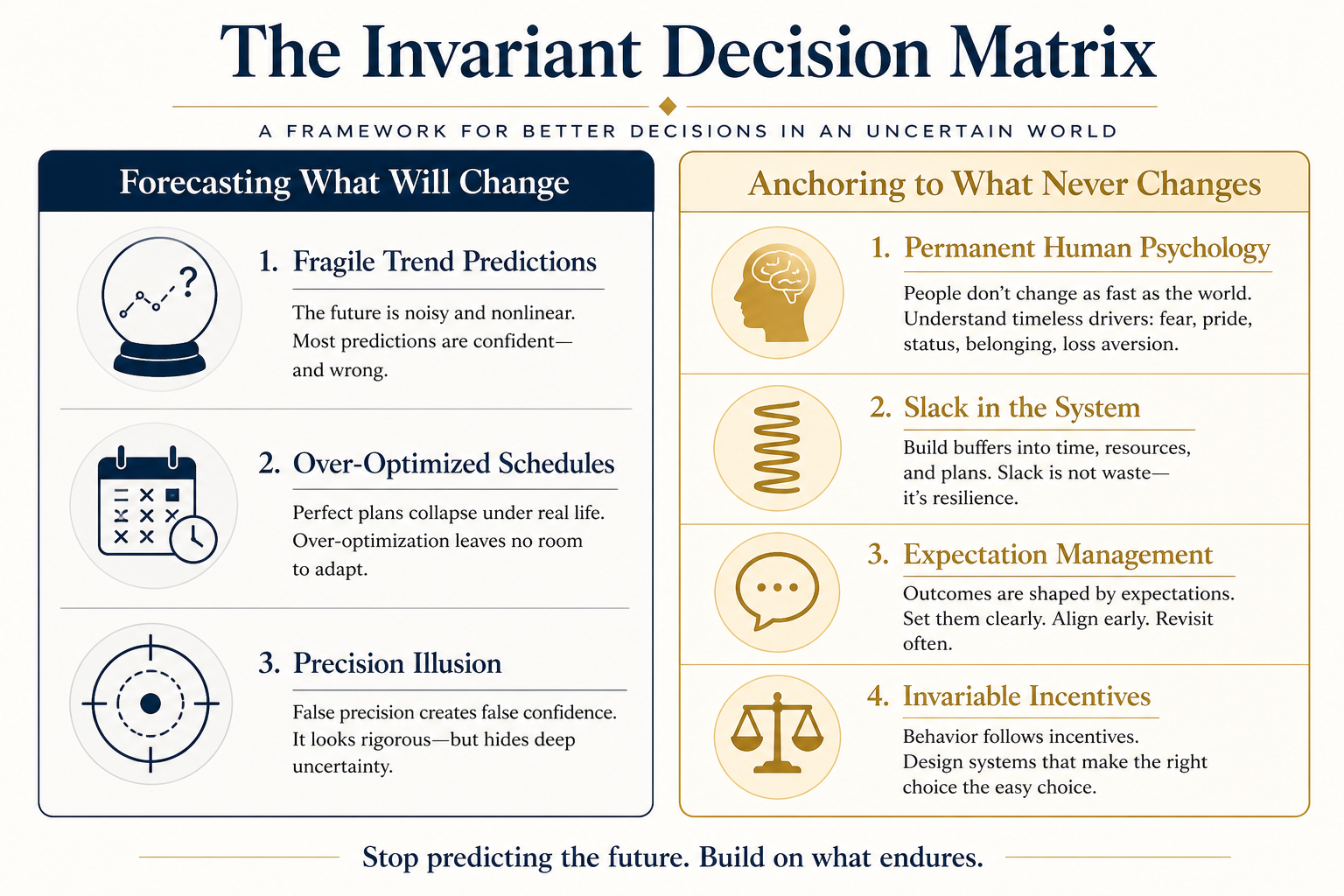
“The things that never change are the most important things to pay attention to, because you can have so much more confidence in how they will shape the future.”
2. The Ideas I Kept Returning To
What stayed with me was not a formula for prediction, but Housel’s insistence that uncertainty deserves humility. We remember history as a clean sequence because the ending is already known. Living through it is different: information arrives out of order, important events look ordinary at first, and confident explanations appear only afterwards.
The book is strongest when it connects that uncertainty to expectations. Progress can be real while disappointment grows, because expectations often move faster than circumstances. Housel’s argument is not that ambition is a mistake. It is that satisfaction depends partly on the distance between what life provides and what we have quietly decided it owes us.
I also kept returning to his idea that experiences leave durable emotional scars. Two people can study the same evidence and reach different conclusions because they have survived different histories. That is a compassionate way to read disagreement: not every opposing view is ignorance; sometimes it is memory protecting itself.
What the book left me asking
Which parts of my own decision-making are based on enduring human behaviour, and which are simply reactions to the most vivid thing I have recently experienced? The question is more useful than pretending the future can be made precise.