Competing on cost-per-device or cost-per-user commoditizes engineering expertise and triggers margin compression. However, shifting to outcome-based pricing without explicit contractual and technical boundaries exposes an MSP to unbounded operational liabilities.
True outcome-centric pricing does not mean guaranteeing subjective business metrics such as client revenue growth or employee productivity. Instead, it means pricing around Measurable Service Conditions: guaranteed recovery time objectives (RTO), verified identity compliance baselines, continuous security posture monitoring, and predictable infrastructure lifecycles.
Target Recurring Margin
Gross profit threshold for fully managed recurring user/seat agreements.
Noise Threshold
Reactive tickets per endpoint per month before pricing true-up riders trigger.
Annual CPI Escalator
Mandatory compounding rate adjustment built into multi-year MSAs.
1. Defining Prerequisite Service Conditions
An MSP can only commit to high-availability outcomes when the client environment adheres to explicit contractual requirements. These operational prerequisites must be written directly into the Master Services Agreement (MSA):
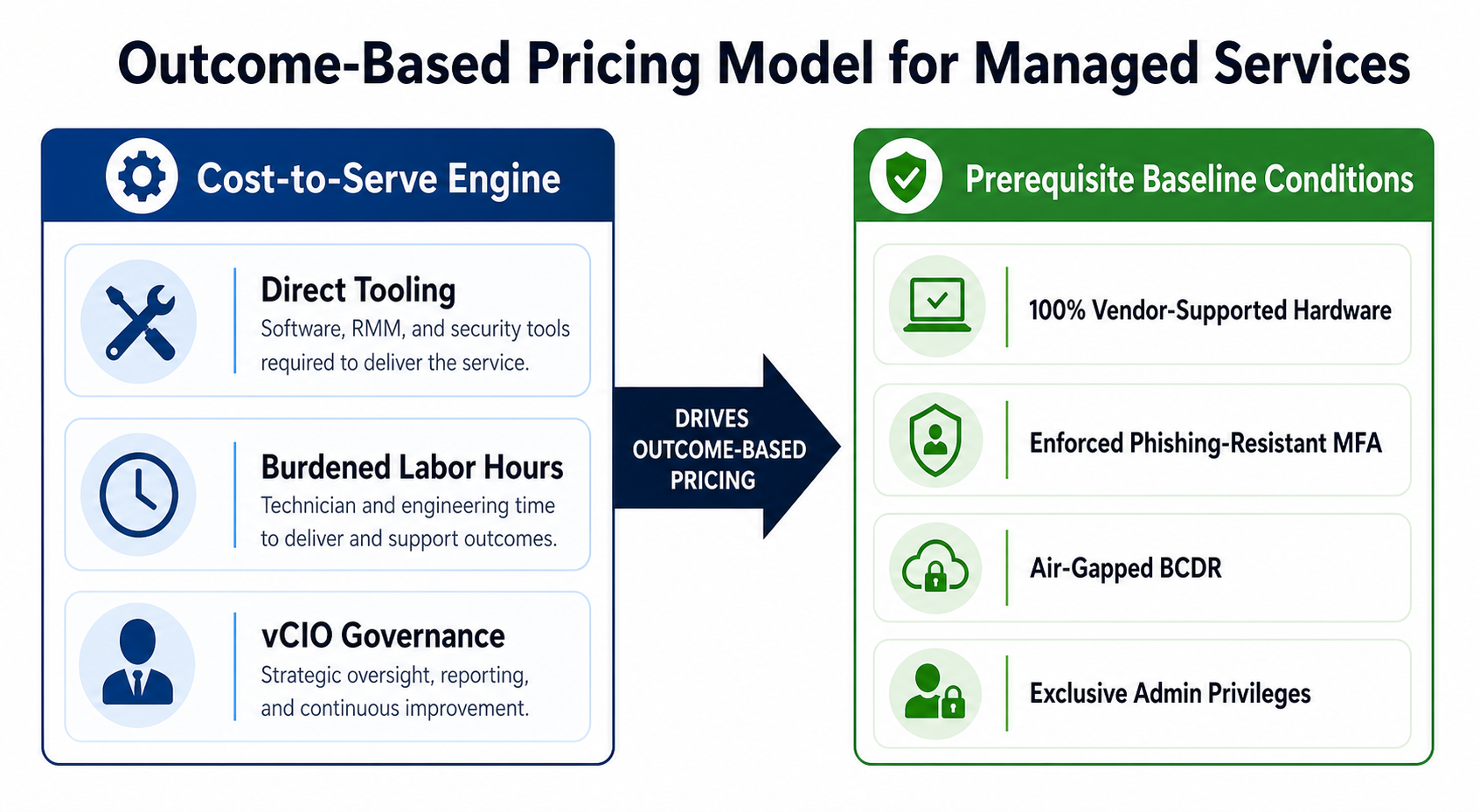
- Hardware Lifecycle Enforcement: Workstations and network appliances beyond vendor end-of-life (EOL) are excluded from standard SLA restoration commitments and billed under remediation rates.
- Identity & Access Controls: All managed accounts must enforce phishing-resistant Multi-Factor Authentication (MFA) and conditional access policies defined by the MSP.
- Exclusive Administration Rights: No third-party or internal client personnel may hold domain or global admin rights without a signed co-managed IT indemnity rider.
“You cannot guarantee recovery times on unpatched infrastructure, nor can you guarantee security outcomes when client staff hold unmonitored administrative privileges.”
2. The Cost-to-Serve Calculation Model
To price contracts with guaranteed gross margins across recurring service lines, MSP leadership must calculate the true Cost-to-Serve using fully burdened unit economics: Direct Tooling Licensing plus Estimated Monthly Ticket Hours multiplied by Burdened Labor Rate plus vCIO Allocation.
| Pricing Model | Billing Mechanism | Client Value Perception | Margin Exposure Risk |
|---|---|---|---|
| Time & Materials (T&M) | Hourly rate for reactive labor. | Low; penalizes efficiency and rewards slow problem resolution. | High; strictly constrained by billable capacity. |
| Flat-Rate Per Device | Fixed monthly fee per endpoint. | Moderate; predictable operating expense for budget planning. | Severe; unstandardized clients generate massive ticket noise. |
| Tiered Service Conditions (Optimal) | Fixed fee tied to verified baseline compliance. | High; aligns price directly with availability, resilience, and security. | Low; deviations from standard architecture trigger scope addendums. |
Scope Governance Rules
- Never bundle complex tenant migrations, office moves, or infrastructure overhauls into flat-rate support agreements.
- Incorporate explicit annual technology cost escalation clauses into every multi-year contract.
- Provide transparent client reporting linking technical investments to reduced downtime and compliance audit readiness.