Banning Artificial Intelligence across your organization is an illusion. When executive leadership bans generative AI tools, employees do not stop using them—they simply paste proprietary financial models, customer PII, and source code into unmanaged consumer ChatGPT accounts on their personal mobile devices.
Mid-market organizations do not need massive enterprise compliance teams to govern AI effectively. They need a Proportional AI Governance Framework: an explicit risk-classification model, approved enterprise AI tools with guaranteed data privacy boundaries, clear acceptable-use policies, and automated Data Loss Prevention (DLP) guardrails.
Zero Model Training
Mandatory contractual requirement that vendor enterprise AI tools never train on corporate data.
AI Risk Classification
Clear classification taxonomy spanning Prohibited, High-Risk, Managed, and Low-Risk use cases.
Shadow AI Discovery
Continuous CASB monitoring tracking employee access to unsanctioned public AI endpoints.
1. The 4-Tier Proportional AI Risk Taxonomy
| Risk Classification | Operational Definition | Real-World Use Case | Mandatory Governance Control |
|---|---|---|---|
| Tier 1: Prohibited AI | Unacceptable risk violating privacy, law, or ethical baselines. | Feeding unredacted customer PII, patient health data, or trade secrets to public consumer AI. | Blocked at firewall/CASB level; strict disciplinary policy. |
| Tier 2: High-Risk AI | Directly impacts employment, credit, legal, or safety decisions. | AI tools used for automated resume filtering or underwriting evaluation. | Mandatory bias audit, executive legal review, and human sign-off. |
| Tier 3: Managed AI | Internal productivity with proprietary business context. | Enterprise Copilots summarizing internal meetings, drafting emails, or analyzing financials. | Mandated enterprise privacy tier (zero data retention / no model training). |
| Tier 4: Low-Risk AI | Publicly available, non-sensitive data manipulation. | Brainstorming marketing copy, reformatting public data, or summarizing public articles. | Permitted with basic employee acceptable-use training. |
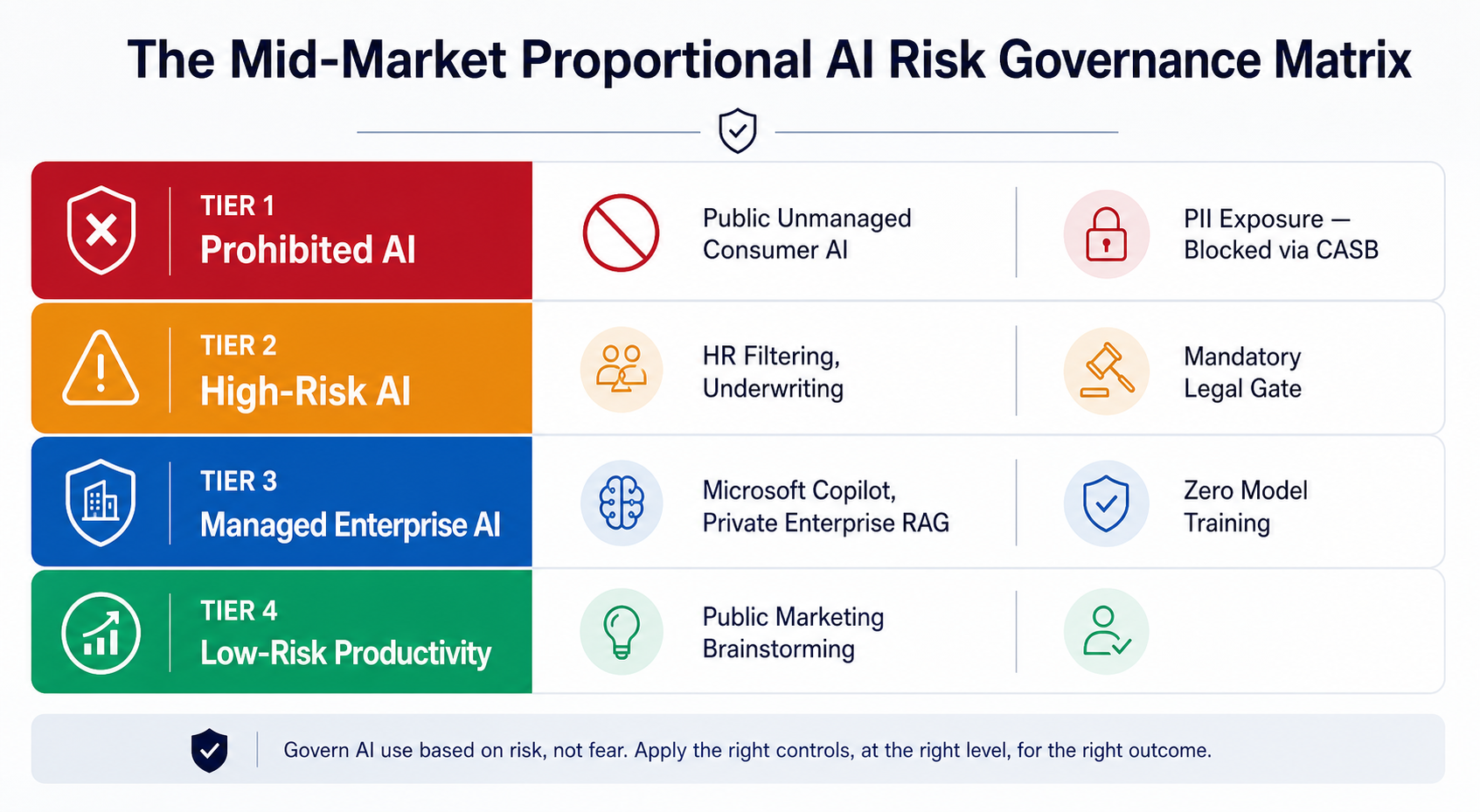
“If you do not provide your employees with a secure, sanctioned enterprise AI tool, you have not stopped AI adoption—you have merely outsourced your corporate data governance to unmanaged consumer platforms.”
2. The Vendor AI Evaluation Framework
Before approving any SaaS tool incorporating AI features, procurement and security leaders must verify four contractual guarantees:
- Zero Data Retention for Model Training: The vendor must contractually state that customer input prompts and enterprise documents are never used to train public foundation models.
- Data Boundary Isolation: Data processed by AI features must remain within your designated tenant geographic region (e.g., US-only / EU-only).
- Cryptographic Transit & Rest Encryption: Prompts and generated vectors must be encrypted using customer-managed or enterprise-grade keys (AES-256).
- Audit Logging & Admin Controls: Enterprise administrators must possess full visibility into which users are querying AI tools and the volume of tokens consumed.
Mid-Market AI Governance Checklist
- Provision enterprise-grade AI accounts (e.g., Microsoft Copilot / ChatGPT Enterprise) with verified commercial data protection.
- Deploy Cloud Access Security Broker (CASB) policies to block unmanaged consumer AI domains on corporate devices.
- Publish a clear 1-page Acceptable Use Policy outlining the difference between Approved vs Prohibited data input types.