Legacy MPLS network architectures were designed for an era when enterprise traffic flowed strictly from branch offices back to an on-premises central data center. When a 41-site retail and logistics enterprise migrated its mission-critical ERP, POS checkout terminals, and communications to Microsoft 365 and cloud SaaS, the legacy MPLS topology collapsed under the strain: hairpinned cloud traffic created severe latency bottlenecks, telecom circuits cost over $52,000 monthly, and single-carrier fiber cuts frequently brought retail checkout lines to a complete halt for hours.
This comprehensive case study examines the multi-site migration from legacy carrier MPLS to an enterprise-grade, application-aware Secure SD-WAN architecture. By deploying active-active dual broadband connections (underlay Fiber + diversified commercial 5G wireless), dynamic IPsec overlay meshes, automated performance SLA health checks, and direct cloud breakout policies, the organization achieved continuous 99.999% network uptime, slashed recurring WAN connectivity expenses by 64%, and delivered sub-second packet steering with zero call drops during active ISP outages.
Recurring WAN OPEX Reduction
Slashed monthly carrier spend from $52,400 (MPLS) to $18,800 across 41 locations by moving to commodity DIA Fiber and 5G lines.
Sub-Second Dynamic Failover
Instantaneous packet redirection between degraded fiber and secondary 5G circuits with zero VoIP jitter or dropped POS sessions.
Verified Branch Network Availability
Zero unscheduled retail store outages across four rolling quarters despite experiencing 19 physical ISP fiber-cut events.
Annual Reclaimed Revenue & Telecom Savings
Calculated by eliminating retail POS checkout register downtime, carrier SLA penalties, and emergency satellite backup dispatch fees.
1. The Architectural Bottleneck: The High Cost of Legacy MPLS Hairpinning
Before the modernization program, the company’s wide-area network suffered from structural inefficiencies that compromised daily retail sales and warehouse logistics:
- The Cloud Hairpinning Bottleneck: All branch Internet and cloud traffic was backhauled over expensive, low-bandwidth 20Mbps MPLS links to the corporate headquarters data center for centralized firewall inspection, introducing 110ms+ of unnecessary latency to cloud applications.
- Single-Carrier Dependency: Each retail location relied on a single local telecom provider. When a municipal backhoe cut a regional fiber bundle, the affected store lost credit card processing, VoIP phones, and inventory tracking for an entire business day.
- Rigorous Provisioning Latency: Opening a new retail location or pop-up distribution site required a 90-day to 120-day carrier provisioning window for MPLS circuit installation, delaying business expansion timelines.
| Network Vector | Legacy MPLS Architecture (Broken Baseline) | Modern Secure SD-WAN (Target State) | Strategic Business Impact |
|---|---|---|---|
| Transport Topology | Single proprietary MPLS circuit per site (hairpinned to HQ). | Active-Active Dual Underlay (Direct Internet Access Fiber + Diversified 5G LTE). | 10x bandwidth capacity at 1/3 the monthly circuit cost. |
| Cloud Access Path | Backhauled 100% through core data center before reaching SaaS. | Direct Internet Breakout (DIA) with integrated Layer-7 NGFW security inspection. | Reduces cloud application latency from 115ms down to 18ms. |
| Outage Failover | Manual cable switching or slow routing protocol convergence (3 to 8 minutes). | Dynamic packet-by-packet steering based on real-time jitter, loss, and latency (< 1 sec). | POS transactions and active Microsoft Teams calls stay live through ISP cuts. |
| Branch Provisioning | 90–120 days lead time for telecom carrier fiber cross-connects. | Zero-Touch Provisioning (ZTP); store comes online in under 2 hours via 5G overlay. | Drastically accelerates retail site launch velocity and seasonal pop-ups. |
| Security Architecture | Decentralized routers lacking native application-aware inspection. | Unified Secure SD-WAN with integrated IPS, SSL Deep Inspection, and Web Filtering. | Eliminates branch security blind spots and simplifies PCI-DSS compliance audits. |
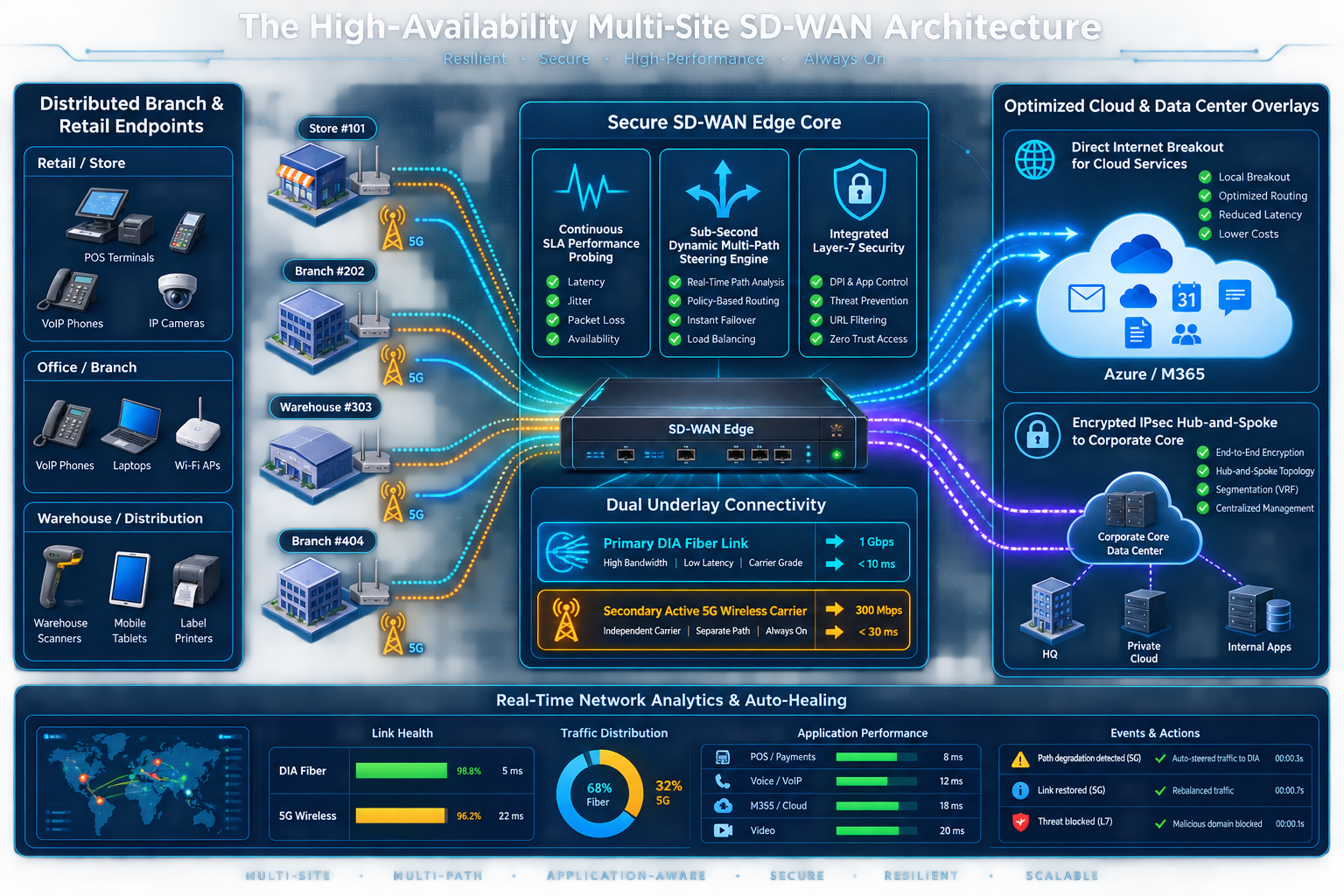
2. The Four-Stage SD-WAN Implementation Playbook
Executing a live network cutover across 41 geographically distributed retail and logistics sites without losing a single hour of trading time required a structured, phased rollout:
- Stage 1: Dual Underlay Carrier Procurement & Edge Staging (Days 1–25):
- Stage 2: Hub & Data Center Overlay Fabric Architecture (Days 26–45):
- Stage 3: Dynamic SLA Rules & Application-Aware Steering Configuration (Days 46–70):
- Stage 4: Pilot Validation, Site Cutover & MPLS Decommissioning (Days 71–90):
3. Deep-Dive Network Engineering: The Dynamic Performance SLA Engine
The operational core of the high-availability network is the continuous SLA probing and policy-based steering engine operating at the edge:
Sd Wan Dynamic Sla Steering
Monitoring Protocol: Bi-Directional Performance Probing (Interval: 1000ms | Failure Threshold: 3 Packets)
SLA Threshold Targets:
  - Voice / Video Class (VoIP, MS Teams): Latency <= 120ms | Jitter <= 15ms | Packet Loss <= 0.5%
  - Transactional Business Class (POS, ERP, Cloud DB): Latency <= 180ms | Packet Loss <= 1.0%
  - Default / Web Browsing Class: Best Effort
Real-Time Dynamic Steering Rules:
  - Normal State: Primary Fiber DIA handles 100% of Voice, POS, and Corporate Cloud. Secondary 5G Carrier handles guest Wi-Fi and offsite backup replication.
  - Incident Trigger [Degraded Fiber State - Packet Loss spikes to 3.2% or Latency > 150ms]:
      * SD-WAN Edge Engine detects SLA breach within 3,000ms.
      * Instantaneously shifts Voice and POS session streams to Secondary 5G Wireless Carrier without tearing down active IPsec security associations.
      * End-User Impact: 0 dropped calls, 0 POS register disconnects.
  - Resolution Trigger [Fiber restabilizes for 300 continuous seconds]:
      * Gracefully re-aligns high-priority traffic to primary fiber underlay; updates centralized NOC telemetry dashboard.
“A resilient enterprise network does not depend on a single carrier's promise of 100% uptime; it is engineered with the mathematical certainty that carriers will fail, and built with the automation required to ensure your business never notices.”
4. The Operational & Strategic Payoff
At the six-month post-cutover operational review, the high-availability SD-WAN deployment delivered transformative results across every business dimension:
- Zero Lost Retail Trading Minutes: During a catastrophic regional storm that severed underground fiber in four cities, all 12 affected retail stores seamlessly shifted to 5G wireless overlays with zero register downtime or sales disruptions.
- Massive Telecommunication Cost Savings: Decommissioning legacy MPLS contracts returned $403,000 in net annualized operational savings straight to the enterprise bottom line.
- Complete Fleet Visibility: The central NOC team now monitors end-to-end network health, per-application bandwidth consumption, and ISP SLA metrics across all 41 sites from a single centralized management pane.
Enterprise SD-WAN Migration Checklist
- Enforce strict carrier diversity at every location; ensure secondary cellular/broadband lines use physically separate last-mile infrastructure from the primary fiber.
- Configure application-aware quality SLA probes rather than simple ping tests to catch brownout conditions (jitter/packet loss) before total blackout occurs.
- Enable direct cloud breakout (DIA) with integrated Layer-7 next-generation firewall security to eliminate performance-degrading data center backhauling.
- Validate sub-second failover capabilities with live physical cable-pull drills during pilot site testing prior to full fleet deployment.