Carol Dweck’s concept of the 'Growth Mindset' is one of the most widely cited ideas in modern leadership, and simultaneously one of the most distorted. Organizations routinely reduce it to a corporate pep talk—praising raw effort regardless of output, celebrating enthusiasm over competence, and treating mindset as an innate virtue rather than a continuous operational practice.
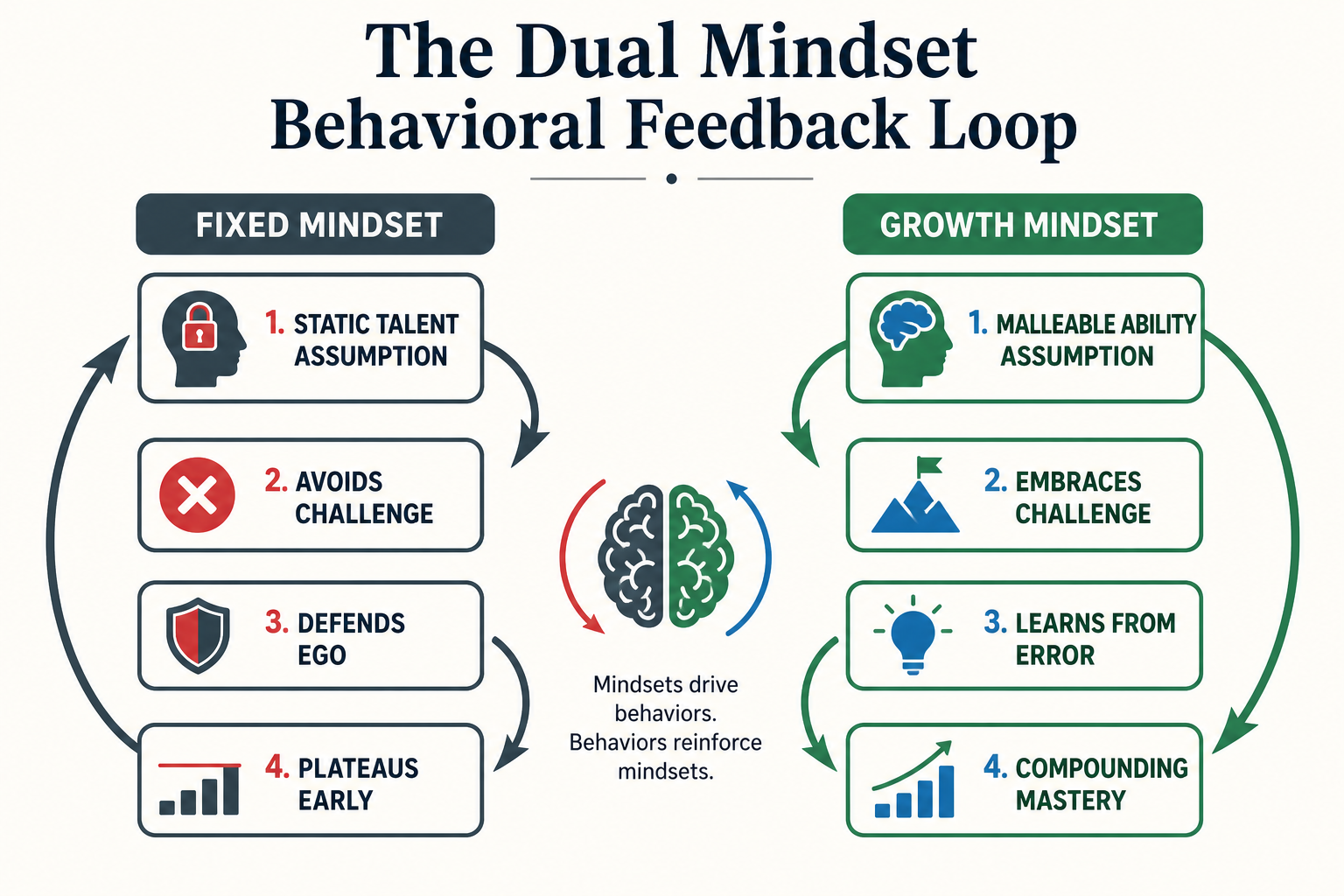
In *Mindset*, Dweck demonstrates that human capability is fundamentally malleable rather than fixed at birth. Believing that competence is static forces individuals and engineering teams into defensive posturing, risk aversion, and fragile self-protection. However, adopting an authentic growth mindset requires structured conditions: diagnosing errors as informational telemetry, designing deliberate practice loops, and institutionalizing the psychological power of 'not yet.'
Scientific Foundation
Synaptic density increases through targeted problem solving and systematic error correction.
Feedback Pivot
Rewarding strategy, focus, and structural iteration rather than innate intelligence or talent.
Cognitive Reframing
Converting static failure ('I can't do this') into a learning trajectory ('I haven't mastered this yet').
1. Fixed Mindset vs. Growth Mindset Architecture
The foundational distinction lies in how an individual or organization interprets difficulty, failure, and peer competence:
| Trigger Context | Fixed Mindset Reaction | Growth Mindset Approach | Organizational Impact |
|---|---|---|---|
| Encountering Technical Difficulty | Avoids challenge; fears exposing lack of innate capability. | Embraces friction as the biological mechanism of skill development. | Expands technical depth and solves complex root-cause anomalies. |
| Production Errors & Setbacks | Defensive rationalization; blames tools, external teams, or bad luck. | Treats failure as diagnostic data to refine systems and processes. | Accelerates incident resolution and honest post-mortem disclosures. |
| Observing Peer Success | Feels threatened; views another engineer's mastery as personal inadequacy. | Deconstructs peer strategies to identify transferable patterns. | Fosters blameless knowledge sharing across engineering pods. |
| Receiving Technical Critique | Interprets feedback as a personal attack or status downgrade. | Uses critique as an external calibration tool to optimize architecture. | Eliminates structural blind spots in code and deployment workflows. |
“Becoming is better than being. The fixed mindset does not allow people the luxury of becoming. They have to already be.”
2. The Useful Idea—and the Danger of Turning It Into Another Label
The durable insight in Dweck’s work is that interpretation affects persistence. If difficulty is read as proof of permanent inadequacy, effort becomes threatening. If it is read as information about what has not been learned yet, trying again remains possible.
But “growth mindset” can become the very label the book warns against. People are praised for sounding positive while structural barriers, weak teaching, exhaustion, or missing resources are ignored. Telling someone to adjust their mindset is not a substitute for changing the conditions in which learning must occur.
I found the book most useful when treated as a lens rather than a personality test. Nobody is permanently fixed or permanently growth-oriented. The response changes by subject, relationship, confidence, and context. The honest question is not “Which mindset am I?” but “Where do I become defensive about not knowing?”
What remained after reading
A mistake can describe a moment without defining a person. That is a modest claim, but it changes the emotional meaning of learning.