If you live to be eighty years old, you have approximately four thousand weeks on Earth. Modern productivity culture treats this finite span as a logistics problem to be optimized with calendar color-coding, inbox-zero hacks, and speed-reading techniques. In *Four Thousand Weeks*, Oliver Burkeman dismantles this fantasy, showing that trying to master time is the very thing that makes us anxious and overwhelmed.
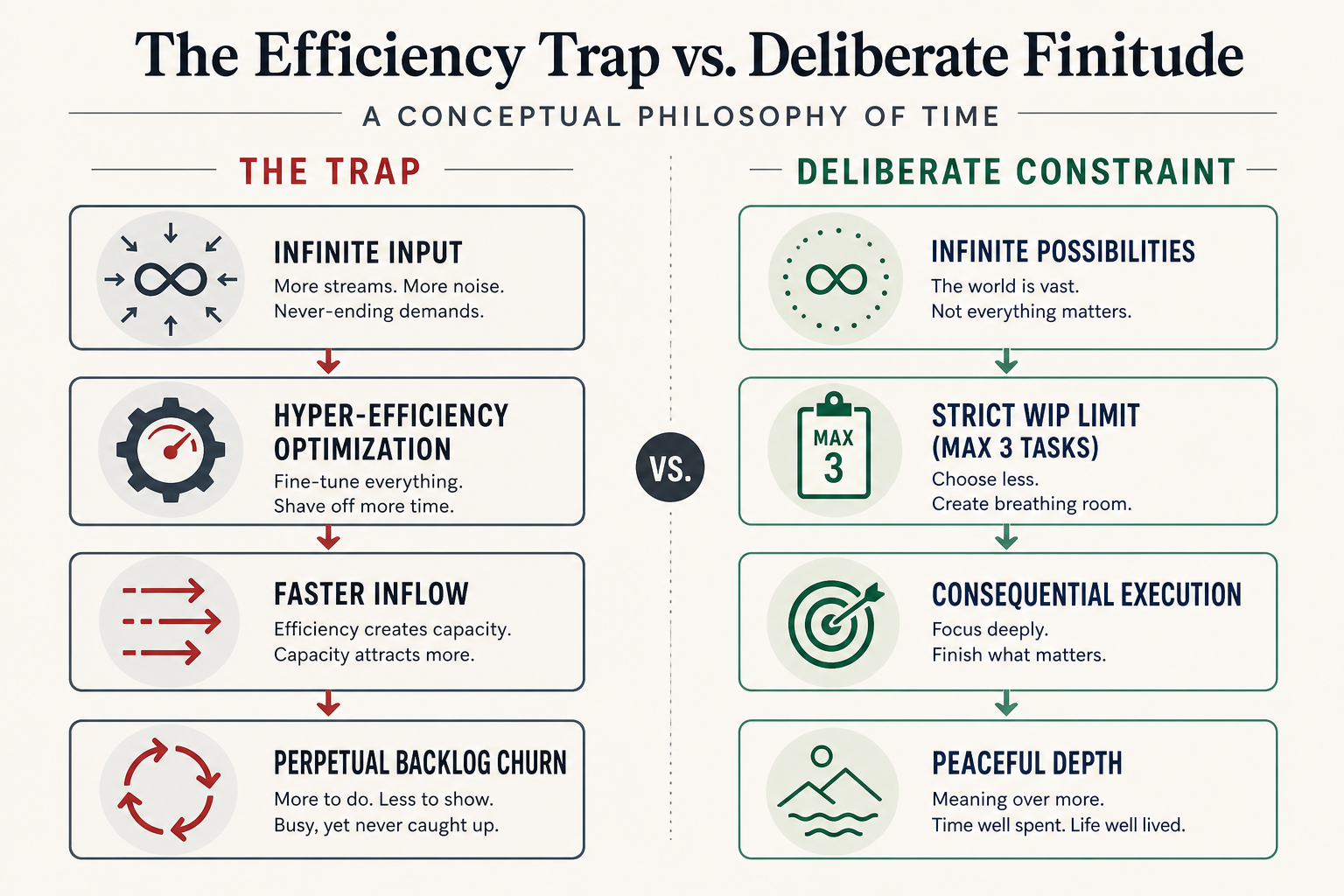
The core paradox of modern work is the Efficiency Trap: the faster you reply to emails, the more emails you generate; the more efficient you become at clearing tasks, the more demands rush in to fill the vacuum. True agency does not come from optimizing your output to fit an infinite backlog. It comes from radical acceptance of your finitude—choosing what to deliberately fail at so you can focus on the consequential few commitments that matter.
Human Lifespan
The average total time available to an individual living to eighty years old.
The Productivity Paradox
Increased throughput attracts higher incoming volume, ensuring the backlog never empties.
The Joy of Missing Out
Embracing the reality that every meaningful choice requires consciously sacrificing infinite alternatives.
1. The Productivity Delusion vs. Finite Reality
Understanding how conventional optimization culture undermines focus requires examining the mechanics of the efficiency trap:
| Productivity Dimension | The Efficiency Illusion (Fails) | The Finitude Realism (Grounded) | Behavioral Impact |
|---|---|---|---|
| Relationship to Backlog | Believing one day you will 'clear the decks' and find peace. | Accepting that the backlog is infinite and will never be completed. | Eliminates perpetual background anxiety and deferred living. |
| Inflow Management | Trying to answer every message and accommodate every meeting. | Establishing hard limits on work-in-progress (WIP) and saying no early. | Protects unbroken blocks of deep strategic attention. |
| Value of Opportunity Cost | Viewing neglected options with regret and FOMO. | Celebrating trade-offs as the proof that a choice has authentic meaning. | Fosters conviction and presence in the chosen commitment. |
| Rest and Leisure | Treating rest instrumentally as fuel for future work productivity. | Engaging in rest as an intrinsically valuable end in itself. | Restores cognitive health without instrumental guilt. |
“The day will never arrive when you finally have everything under control—when the flood of emails has been dammed and your to-do list is finally empty. Once you realize this, the burden of trying to do it all simply falls away.”
2. The Five Practices of Time Finitude
Translating the acceptance of finite time into daily operational focus requires concrete constraints:
- Adopt a 'Fixed Volume' Workflow: Keep an open 'Someday' backlog, but cap your active 'Doing' queue at three tasks maximum. Never add a fourth until one is completed or explicitly abandoned.
- Practice Strategic Underachievement: Decide in advance which minor administrative domains you are willing to perform poorly in (or automate ruthlessly) to excel in core architecture.
- Resist the Lure of Convenience: Fast, frictionless digital tools often degrade the depth and texture of human relationships and intellectual work.
- Settle Deliberately: Acknowledge that choosing a career path, spouse, or technical architecture means renouncing all alternatives. Settling is not defeat; it is the prerequisite for real-world engagement.
Time Finitude Action Checklist
- Delete task management tools that encourage maintaining lists of 200+ active items.
- Define a daily stop-time for work and enforce it regardless of unread notifications.
- Identify one major project you will abandon this week to free capacity for your primary objective.