In the alternate history of *For All Mankind*, the space race never ended. The Soviet Union reaches the Moon first, catalyzing an unrelenting, multi-decade expansion of space exploration that pushes humanity from lunar bases to Mars. Beneath the geopolitical thrill lies one of television's most accurate depictions of mission-driven engineering teams operating at the extreme margins of technical risk and physical safety.
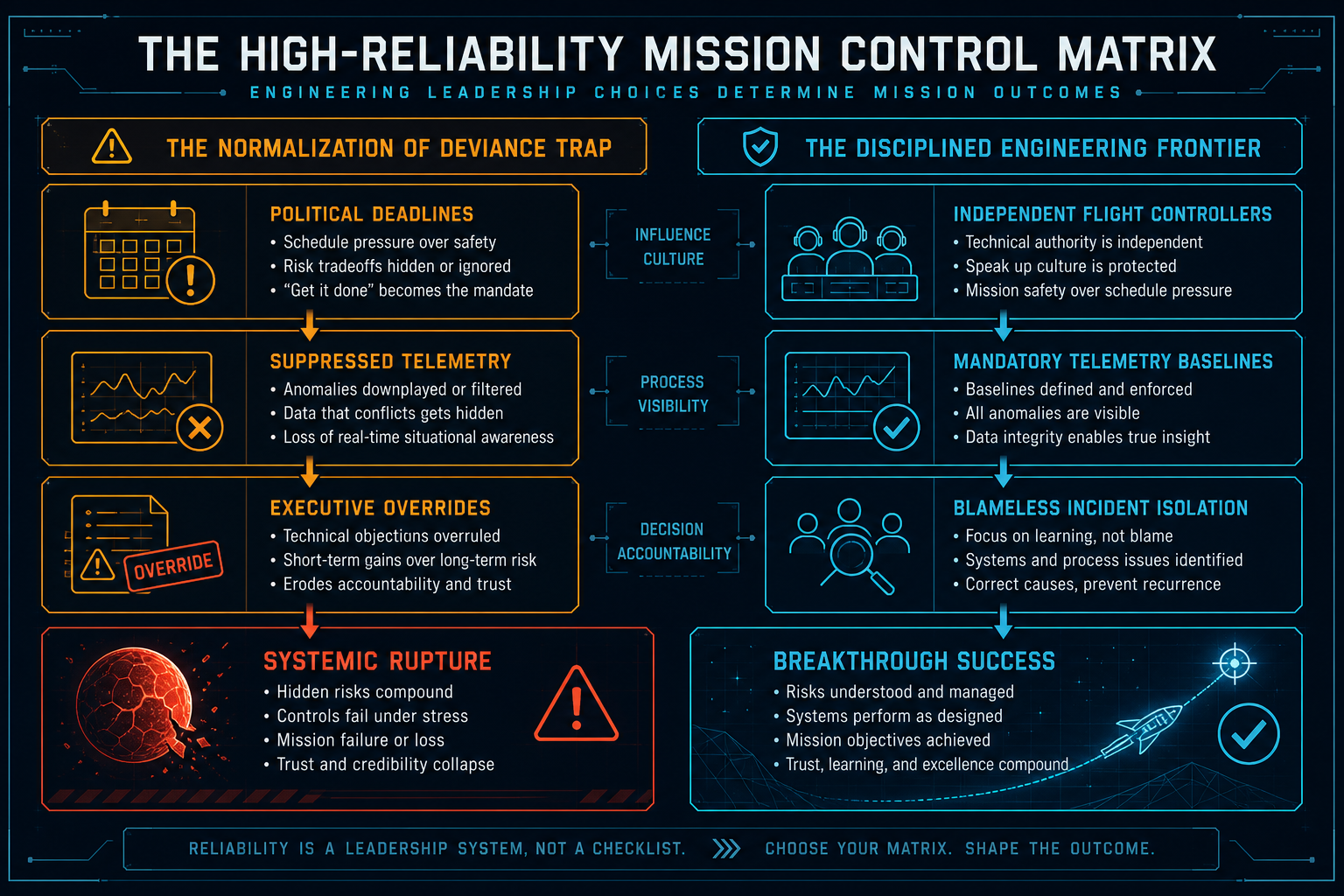
The series illustrates the delicate tension that exists in every high-stakes technical enterprise: the balance between daring ambition and disciplined operational governance. When political mandates, competitive ego, and compressed launch windows override telemetry and engineering warnings, catastrophic structural failures occur. Conversely, when teams build cultures of transparent dissent, rigorous testing, and rapid post-failure recovery, they achieve breakthroughs previously deemed physically impossible.
Operating Envelope
Designing life-critical systems where minor telemetry anomalies can trigger total mission loss.
The 'Go/No-Go' Standard
Empowering frontline technical operators to veto executive launches based on safety metrics.
Failure Transformation
Converting launch disasters into root-cause engineering upgrades without scapegoating individuals.
1. Competitive Ambition vs. Operational Safety
The aerospace race forces leaders to continuously balance aggressive mission timelines against life-critical engineering parameters:
| Operational Dynamic | Compromised Decision (Failure Mode) | High-Reliability Practice (Resilient) | Engineering Principle |
|---|---|---|---|
| Launch Schedule Pressure | Suppress sensor anomalies to beat a geopolitical competitor to Mars. | Abort launch; conduct root-cause telemetry isolation despite public optics. | Schedule pressure must never override immutable physical constraints. |
| Telemetry Discrepancies | Dismiss minor engine pressure fluctuations as acceptable sensor noise. | Halt operations immediately; analyze delta against baseline calibration limits. | Normalization of deviance is the primary precursor to catastrophic failure. |
| Flight Director Authority | Executive leadership overrules technical controllers to preserve funding. | Flight Director retains absolute autonomous authority over mission parameters. | Operational command must reside with technical practitioners, not political stakeholders. |
| Multi-Team Collaboration | Hoard proprietary engine data between NASA, Soviets, and private space firms. | Share critical atmospheric and fuel telemetry during emergency rescue operations. | Shared survival in hostile environments requires operational interoperability. |
“Space is an unforgiving environment. It does not care about national pride, investor expectations, or arbitrary calendar deadlines. The physics either works, or everyone dies.”
2. When Ambition Becomes Intimate
The alternate-history premise works because public achievement is always tied to private cost. Ed Baldwin’s drive cannot be separated from grief, pride, and the damage his certainty causes at home. Danielle Poole’s authority grows through restraint and judgment rather than spectacle. Molly Cobb’s courage is inseparable from the consequences she accepts.
The space programme rewards people for pushing limits while depending on procedures written in response to earlier loss. That tension gives the missions weight. Technical risk is never merely technical when families wait on Earth, political leaders need a victory, and crews must decide whether loyalty means obedience or intervention.
Not every melodramatic turn lands, and the expanding timeline occasionally sacrifices subtlety. Still, the series earns its optimism by refusing to make progress clean. Achievement changes history, but it does not protect its participants from jealousy, secrecy, addiction, compromise, or grief.
Why the series works
The rockets create scale; the relationships create consequence. Without both, the alternative history would be only a timeline.