The word *priority* entered the English language in the fourteenth century as a singular noun. It meant the prior, the single first thing. Only in the twentieth century did people pluralize the term and start speaking of 'priorities'—falsely believing they could have multiple first things simultaneously.
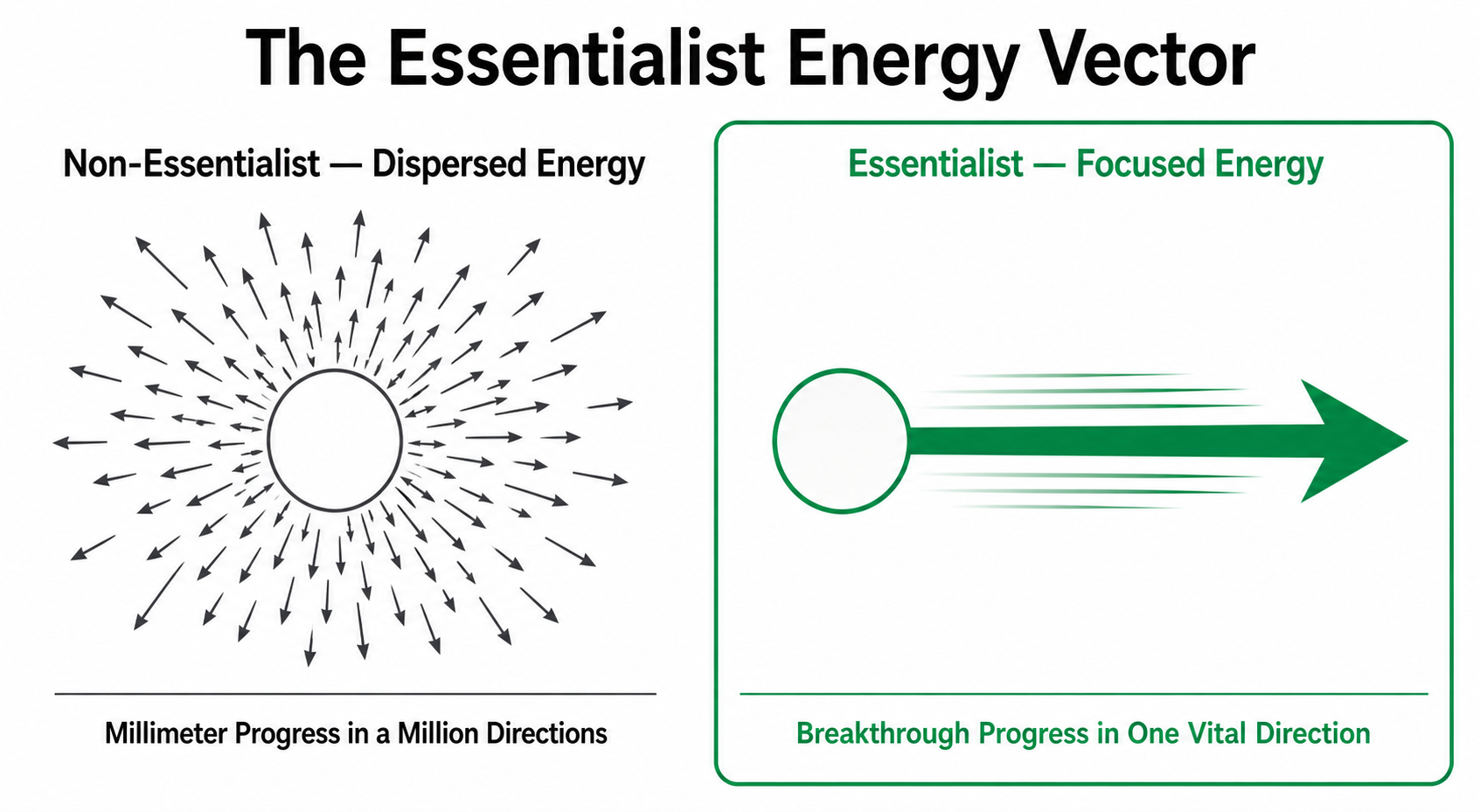
In *Essentialism*, Greg McKeown dismantles the modern myth of 'having it all' and doing it all. When leaders spread their energy in a million different directions, they make millimeter progress in a hundred trivial lanes. Essentialism is the relentless, disciplined pursuit of less but better—making deliberate trade-offs to channel energy into the vital few initiatives that truly matter.
Strict Selection Filter
If an opportunity or request is not a definitive 90%+ 'Yes', treat it as a definitive 'No'.
Pareto Focus
Systematically eliminating the trivial 80% to accelerate the 20% that drives real impact.
Strategic Choice
Essentialists ask 'What am I willing to go small on in order to go big on what matters?'
1. The Non-Essentialist vs. The Essentialist
| Operating Dimension | The Non-Essentialist (Overwhelmed) | The Essentialist (High Impact) | Strategic Consequence |
|---|---|---|---|
| Mindset & Belief | "I have to do it all. It is all important. How can I fit this in?" | "Almost everything is noise. Few things are vital. What is the real priority?" | Non-essentialists suffer from chronic burnout; essentialists operate with calm clarity. |
| Decision Making | Reactive agreement; says yes to every request to avoid social discomfort. | Pauses, evaluates trade-offs, and says no gracefully to non-essentials. | Protects calendar for consequential strategic execution. |
| Energy Allocation | Disperses energy in all directions, making millimeter progress on 50 tasks. | Channels concentrated energy in one direction, achieving breakthrough momentum. | Delivers tangible, transformative business milestones. |
“If you do not prioritize your life, someone else will.”
2. Where the Book Convinced Me—and Where It Felt Too Neat
McKeown is persuasive about the hidden cost of an unexamined yes. A commitment occupies more than the hour visible in a calendar: it brings preparation, switching, emotional residue, and the opportunity that could not be accepted later. The book made selection feel less like selfishness and more like responsibility.
Where I am less convinced is the suggestion that everyone has equal freedom to choose. Care work, financial dependence, organisational hierarchy, and family obligations can make a graceful no genuinely costly. The principle still matters, but its application depends on power and circumstance.
The most useful reading, then, is not “remove everything difficult.” It is “notice what you are repeatedly sacrificing without choosing.” Essentialism works best as a question about deliberate trade-offs, not as a minimalist identity.
A reading reflection
What deserves a protected place in my life—and what continues only because I have never consciously decided to stop it?