The most common mistake in technology succession planning is promoting the best individual contributor—the coding wizard or the top escalation engineer—directly into a management role without preparation, and then wondering why team morale collapses and project velocity drops.
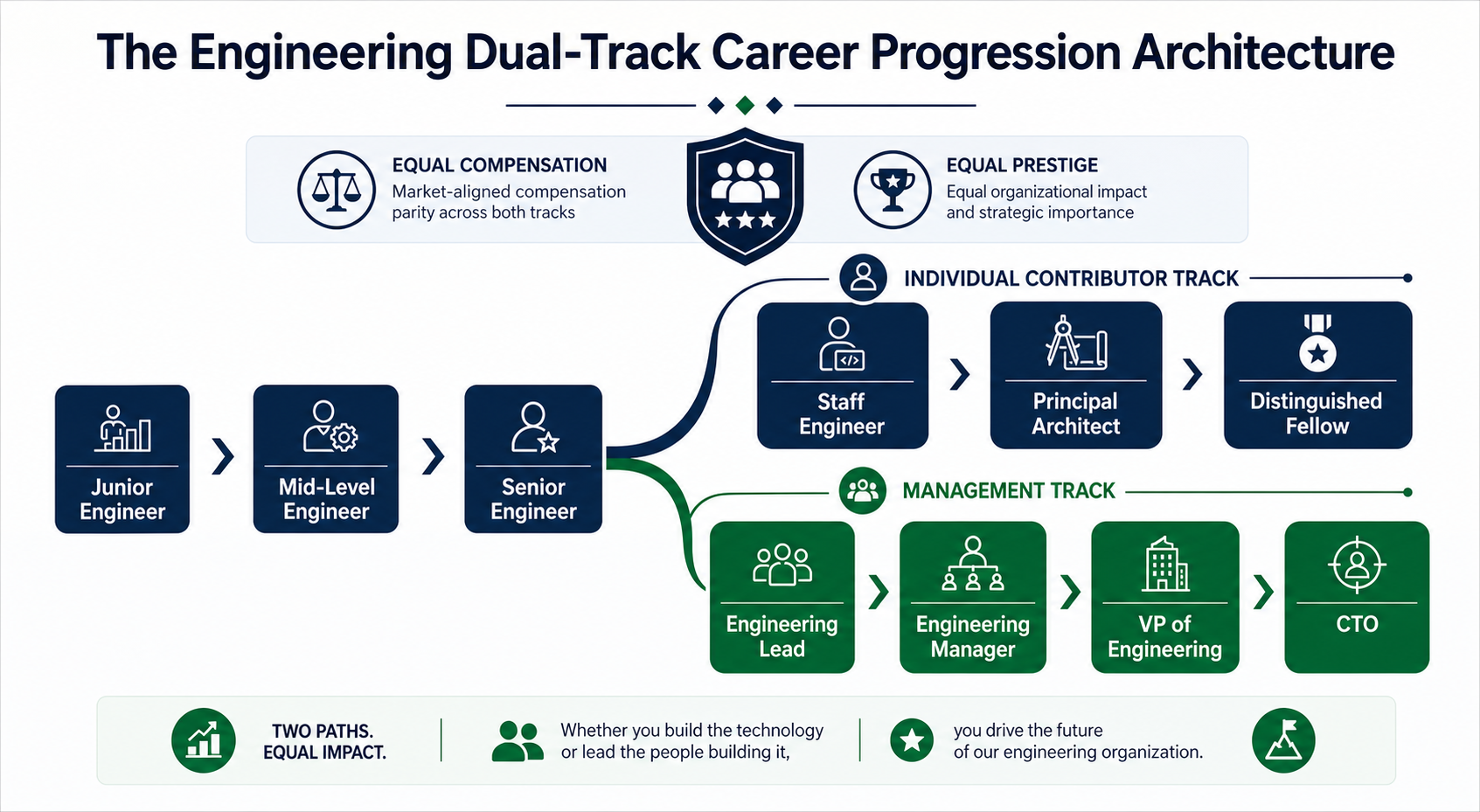
Great technology leaders do not emerge spontaneously; they are deliberately cultivated. Building a robust leadership pipeline requires providing senior engineers with progressive decision exposure, bounded commercial authority, structured executive mentoring, and clear career dual-tracks that separate technical mastery from people management.
Succession Depth
Minimum designated internal successor candidates identified for every critical technical lead role.
Career Architecture
Parallel compensation ladders for Principal Architects and Engineering Managers.
Leadership Runway
Minimum duration of structured leadership shadowing prior to formal management promotion.
1. The Dual-Track Career Architecture
To prevent pushing brilliant individual contributors into management against their strengths, organizations must establish parallel compensation and prestige tracks:
| Career Track | Primary Role Focus | Core Evaluation Criteria | Key Deliverable Focus |
|---|---|---|---|
| Individual Contributor (IC) Track | Deep technical mastery, complex systems design, and golden architecture. | Technical innovation, system resilience, and architectural elegance. | Golden Master templates, core codebases, and high-complexity RFCs. |
| Management & Leadership Track | People development, organizational cadence, resource allocation, and strategy. | Team retention, operational velocity, psychological safety, and margin. | Capacity models, performance reviews, hiring pipelines, and budget narratives. |
“If the only way for a brilliant engineer to increase their compensation is to become a mediocre manager, you will simultaneously lose a great engineer and gain a terrible leader.”
2. The Progressive Decision Exposure Model
Developing engineering leaders requires exposing high-potential candidates to increasing levels of decision complexity before giving them title authority:
- Phase 1 (Incident Command Exposure): Rotate emerging leaders into Incident Commander roles during major Sev-1 outages to build triage composure and stakeholder communication skills.
- Phase 2 (Budget & Vendor Sizing): Involve senior engineers in commercial vendor evaluations, requiring them to draft CapEx/OpEx justifications alongside technical specs.
- Phase 3 (Hiring & Mentorship Ownership): Assign emerging leads as primary interviewers and onboarding mentors for junior engineering cohorts.
- Phase 4 (Strategic Roadmap Delegation): Delegate the creation and defense of an entire technology domain roadmap (e.g., identity modernization) to the candidate.
Technology Leadership Development Checklist
- Implement a formal Engineering Dual-Track ladder ensuring Principal Architects earn parity with Directors of Engineering.
- Establish monthly 'Behind the Closed Doors' executive mentoring sessions reviewing real board narratives and financial budgets.
- Require all technical leads to identify and actively mentor at least one designated succession candidate.