In early-stage technology service providers, technical competence is concentrated in the minds of two or three senior engineers. As client count scales, these senior practitioners become operational bottlenecks, spending their days unblocking routine escalations rather than codifying repeatable delivery systems.
A Center of Excellence (CoE) is the organizational mechanism that transforms isolated engineering expertise into codified standards, governed technical patterns, and automated delivery capabilities. When structured effectively, a CoE does not operate as an administrative approval committee; it functions as an enablement engine that equips frontline support engineers to resolve complex incidents reliably on first touch.
Golden Master Pass Rate
Proportion of new client deployments adhering strictly to standard configuration baselines.
Tier 3 Escalation Deflection
Reduction in senior engineer escalation load within 180 days of standard runbook rollout.
Automation Coverage
Percentage of routine service requests resolved via automated orchestration scripts.
1. Selecting the Right CoE Operating Model
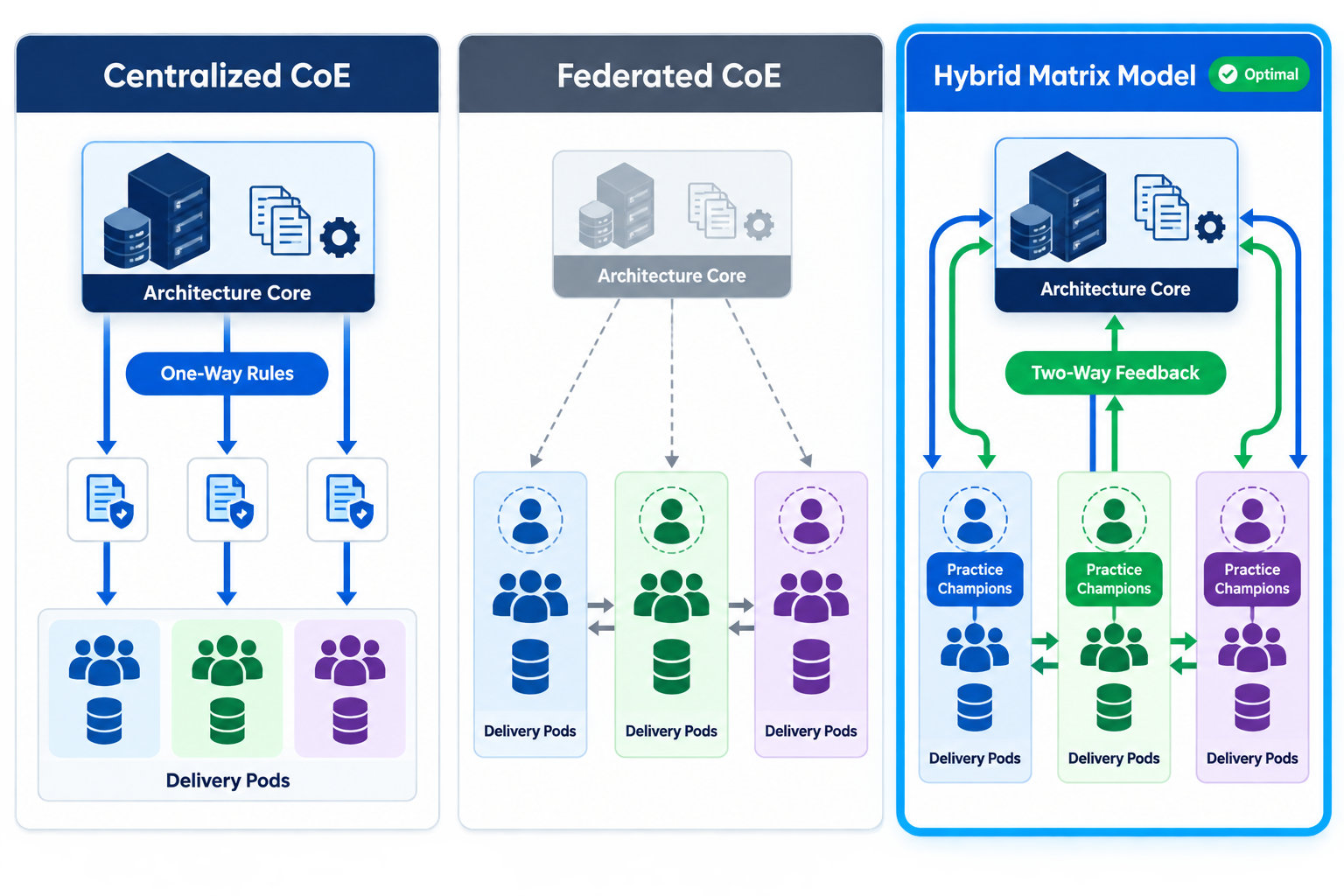
The structure of an MSP's technical governance determines both its operational agility and the field adoption rate of its standards. Service providers must evaluate three distinct organizational models:
| Operating Model | Organizational Structure | Core Benefit | Primary Risk to Mitigate |
|---|---|---|---|
| Centralized CoE | Dedicated, full-time architecture and standards team. | Maximum standard consistency and documentation governance. | Operational disconnect from frontline ticket realities; ivory-tower lag. |
| Federated CoE | Senior engineers embedded directly inside operational delivery pods. | Immediate practical relevance and rapid frontline feedback loops. | Standards divergence across pods and inconsistent quality control. |
| Hybrid Matrix (Optimal) | Central architecture lead partnering with designated pod practice champions. | Scalable governance combined with strong frontline field adoption. | Role ambiguity between billable client hours and standards development time. |
2. Core Functional Pillars of an MSP CoE
An effective technical Center of Excellence operates across four core capability domains to systematically lower the skill floor required for reliable service delivery:
Golden Master Baselines
Designing, validating, and maintaining standard configuration templates for Entra ID tenant baselines, Intune compliance policies, backup retention frameworks, and network segmentation blueprints.
Runbook Engineering & Automation
Converting complex multi-step technical procedures into automated PowerShell/API scripts and strictly sequenced Standard Operating Procedures (SOPs).
Vendor Technology Vetting
Conducting benchmark-driven technical and commercial evaluations before any new security, backup, or RMM tool enters the service catalogue.
Post-Incident Root-Cause Governance
Reviewing major service disruptions (P1 escalations) to identify underlying architectural gaps and prevent systemic reoccurrence across the client fleet.
“The goal of a Center of Excellence is not to hoard technical authority, but to continuously lower the skill floor required to deliver flawless operational outcomes.”
3. Preventing Bureaucratic Inertia & Change Fatigue
The primary failure mode of technical governance initiatives is the creation of bureaucratic drag. If introducing a standard configuration update requires multiple committee approvals, frontline engineers will bypass the process entirely.
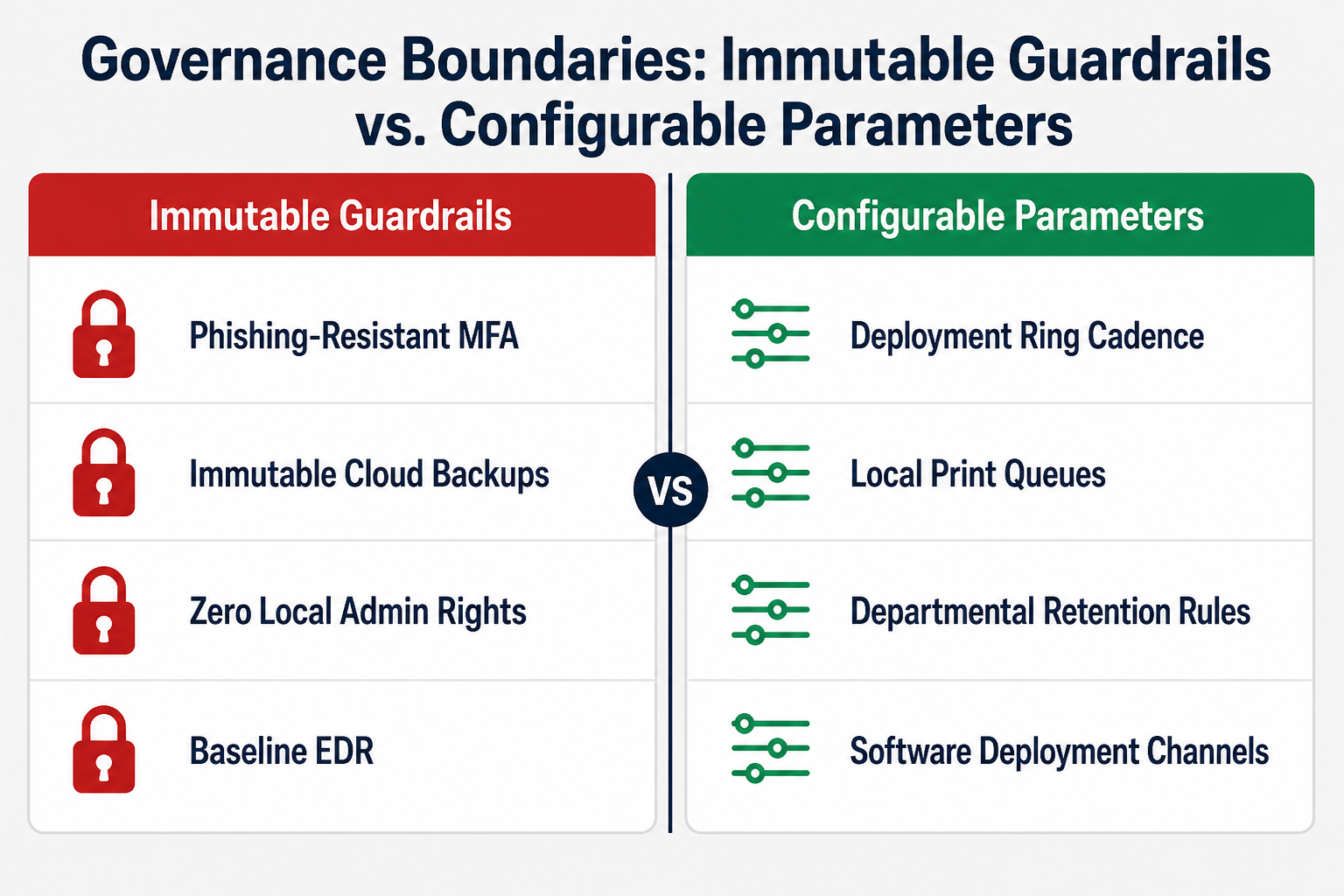
To maintain agility, the CoE must enforce a clear distinction between Immutable Guardrails (mandatory security baselines, MFA enforcement, backup immutability) and Configurable Parameters (client-specific retention schedules, printer mappings, deployment rings). Guardrails are non-negotiable; configurable parameters are delegated to frontline service leads within defined bounds.
CoE Execution Checklist
- Formalize a Hybrid Matrix: Appoint one lead solutions architect and designate one practice champion in each delivery pod.
- Establish Golden Master Baselines: Audit your client base against a single standardized Microsoft 365 and Intune policy set.
- Institute SOP Lifecycle Reviews: Ensure zero operational runbooks remain unreviewed beyond 180 days.
A useful CoE therefore has a paradoxical mandate: centralize the rules that protect quality, security, and resilience, while decentralizing as many safe operational decisions as possible. Its success is not measured by the number of documents it publishes. It is measured by fewer avoidable escalations, faster dependable delivery, and the extent to which good engineering becomes ordinary rather than exceptional.