In most IT departments, documentation is a graveyard. Runbooks live in fragmented Word documents, legacy OneNote notebooks, personal engineer notes, and disconnected wiki pages that are out of date the moment they are written.
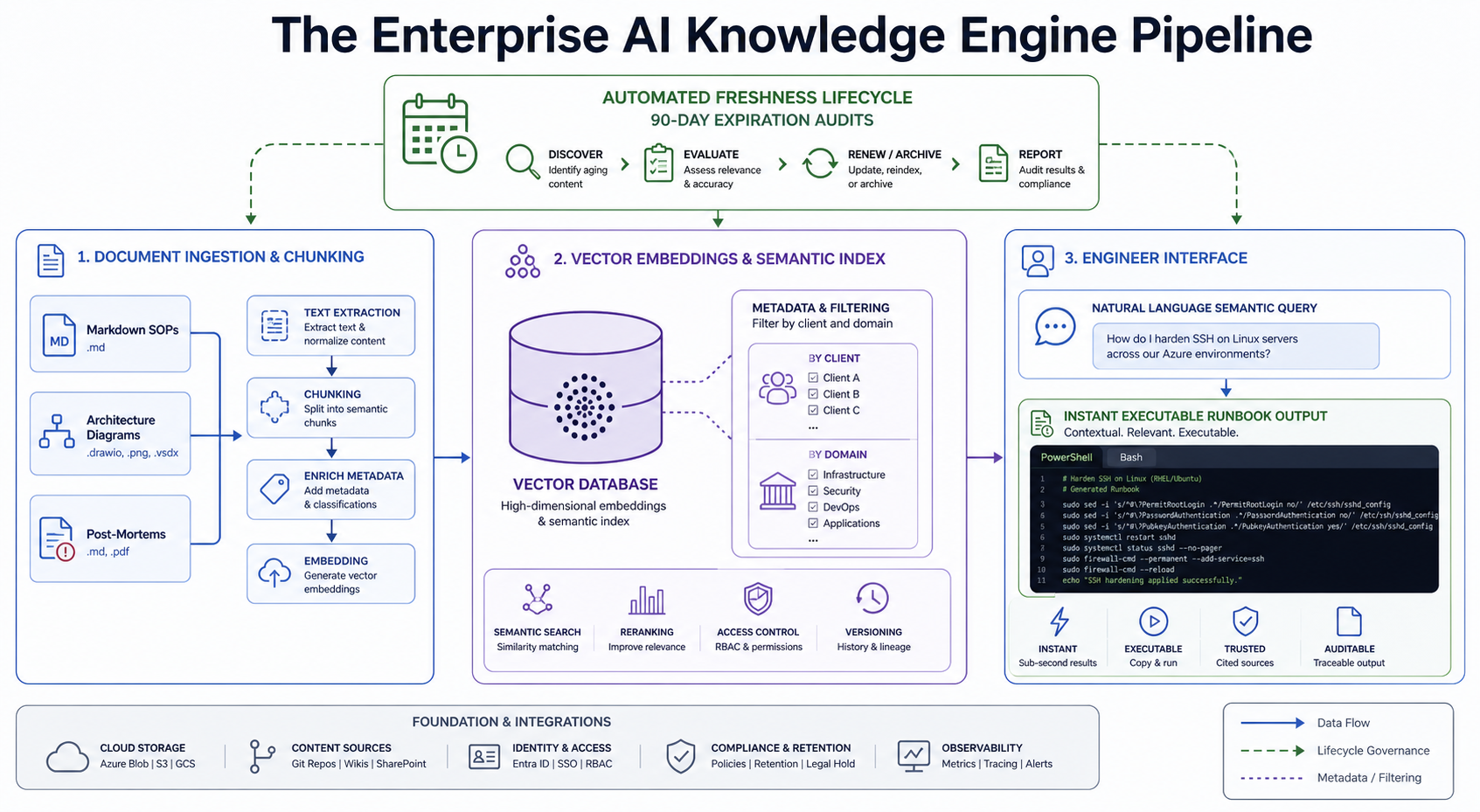
A modern Knowledge Engine is not a passive document repository; it is an active, governed operational subsystem. By utilizing vector embeddings, semantic search, automated freshness verification cadences, and controlled generative AI interfaces, organizations ensure that frontline engineers instantly access verified, executable technical truth during critical incidents.
Knowledge Retrieval Speed
Time required for an engineer to query natural language and retrieve exact runbook parameters.
Knowledge Ownership
All operational runbooks assigned to explicit domain owners with automated 90-day review gates.
Tier 1 First-Touch Resolution
Increase in first-touch incident closures powered by verified AI knowledge retrieval.
1. Passive Document Wiki vs. Active AI Knowledge Engine
| Knowledge Dimension | Passive Legacy Wiki (Flawed) | Modern AI Knowledge Engine (Advanced) | Operational Value |
|---|---|---|---|
| Search Architecture | Exact-match keyword search returning 50 irrelevant articles. | Semantic vector search understanding engineering context and intent. | Pinpoints exact syntax and steps immediately. |
| Content Governance | Unowned, unverified documents rotting for years. | Mandatory ownership tags with automated review deadlines and SLA gates. | Guarantees documentation reflects current production truth. |
| Delivery Interface | Static text pages requiring manual parsing by engineer. | Interactive conversational copilot extracting parameters and code snippets. | Eliminates manual searching during active outages. |
| Feedback Loops | No mechanism to report inaccurate documentation. | Integrated 1-click 'Runbook Succeeded / Failed' rating with bug tracking. | Continuously refines operational procedures based on field usage. |
“If an engineer cannot find the correct operational procedure within thirty seconds during an outage, the documentation does not exist. Accessibility is an architectural requirement, not a convenience.”
2. The 4-Step Knowledge Governance Lifecycle
- Standardized Markdown Templating: Mandate that every operational runbook follow a uniform schema (Prerequisites, Architectural Context, Step-by-Step Execution, Rollback Plan, Verification Command).
- Automated Vector Chunking: Ingest documentation into an embedded vector database (e.g., Azure AI Search / Pinecone) optimized for semantic retrieval by error codes and system roles.
- Mandatory Freshness Gates: Configure automated alerts notifying document owners 14 days before a runbook reaches its 90-day verification expiration date.
- Post-Incident Knowledge Extraction: Mandate that every major incident post-mortem publishes an updated or new runbook as a non-negotiable exit criterion.
Knowledge Engine Deployment Checklist
- Migrate all unstructured Word/PDF documentation into a unified Markdown/Git-backed repository.
- Implement metadata tagging: ClientID, Environment, TechnologyDomain, and AuthorRole on all documentation.
- Establish an automated reward mechanism recognizing senior engineers who author the most frequently executed runbooks.