In modern cyber warfare, backups are no longer an insurance policy hidden away in an IT closet—they are the primary target of ransomware adversaries. When a 12-plant manufacturing enterprise relied on legacy on-premises tape libraries and unhardened Windows CIFS network shares, data protection was vulnerable by design: manual tape rotations failed frequently, backup jobs regularly missed their nightly windows, and existing backup repositories were directly susceptible to credential compromise and immediate encryption during an active intrusion.
This enterprise case study examines the end-to-end modernization of an 180TB multi-site backup architecture. By replacing brittle tape rotations and vulnerable SMB/CIFS repositories with an air-gapped, immutable hybrid topology utilizing Veeam Backup & Replication v12, on-premises Linux Hardened Repositories, and public cloud Immutable Object Storage (WORM), the organization achieved strict 3-2-1-1-0 compliance, compressed Recovery Point Objectives (RPO) to 15 minutes, and reduced Recovery Time Objectives (RTO) by 82%.
Recovery Time Objective (RTO)
Compressed full production cluster restore time from 26 hours (tape retrieval) down to 4.7 hours via instant VM recovery.
Immutable WORM Protection
Air-gapped, immutable Linux XFS and cloud object locks preventing modification, encryption, or deletion for 30 days.
Automated Recovery Verification
Veeam SureBackup automated sandboxed boot verification testing 100% of production workloads daily without manual technician effort.
Annual Tape Logistics & Hardware Savings
Eliminated third-party offsite tape transport contracts, tape drive maintenance renewals, and dedicated storage appliances.
1. The Legacy Vulnerability: Why Traditional Backups Fail During Cyber Extortion
Prior to the transformation, the company operated a legacy data protection posture that introduced significant operational risk and potential points of failure:
- Windows/SMB Repository Vulnerabilities: Backups were stored on Windows-based NAS volumes using standard domain admin credentials. In the event of Active Directory compromise, an adversary could instantly format or encrypt the backup targets.
- Brittle Tape Logistics: Offsite physical tapes were driven to a third-party vault weekly. Restoring a critical database required physical recall logistics, introducing a minimum 24-hour latency before recovery could even begin.
- Unverified Recovery Integrity: Backups finished with a simple 'Job Completed' status, but no regular boot or application consistency testing was conducted, leaving silent database corruption entirely undetected.
| Protection Vector | Legacy Architecture (High Risk / Fails) | Modernized Veeam Hybrid Architecture (Target State) | Strategic Business Impact |
|---|---|---|---|
| Repository Hardening | Windows-joined NAS with domain admin access (vulnerable to ransomware). | Linux Hardened Repository with XFS fast-clone and immutable block locking. | Backups cannot be deleted or encrypted, even with full domain administrative compromise. |
| Cloud Tiering Strategy | Manual tape export shipped once weekly to physical offsite vault. | Veeam Scale-Out Backup Repository (SOBR) with automated S3/Blob Object Lock. | Instant, encrypted offsite replication with zero physical handling or logistics delay. |
| RPO & Backup Windows | 24-hour backup window; massive nightly performance hit on ERP databases. | 15-minute CDP and synthetic fulls using storage snapshot integration. | Eliminates production system slowdowns; limits data loss window to minutes. |
| Recovery Validation | Blind trust; manual restore testing performed once a year during audits. | Automated nightly SureBackup testing inside isolated, air-gapped sandboxes. | 100% verified recoverability for all mission-critical ERP and SCADA workloads. |
| Compliance Rule | Outdated 3-2-1 Rule (Lacked immutability and verification standards). | Enforced 3-2-1-1-0 Rule (3 copies, 2 media types, 1 offsite, 1 immutable, 0 restore errors). | Complies with cyber insurance mandates and eliminates ransomware extortion leverage. |
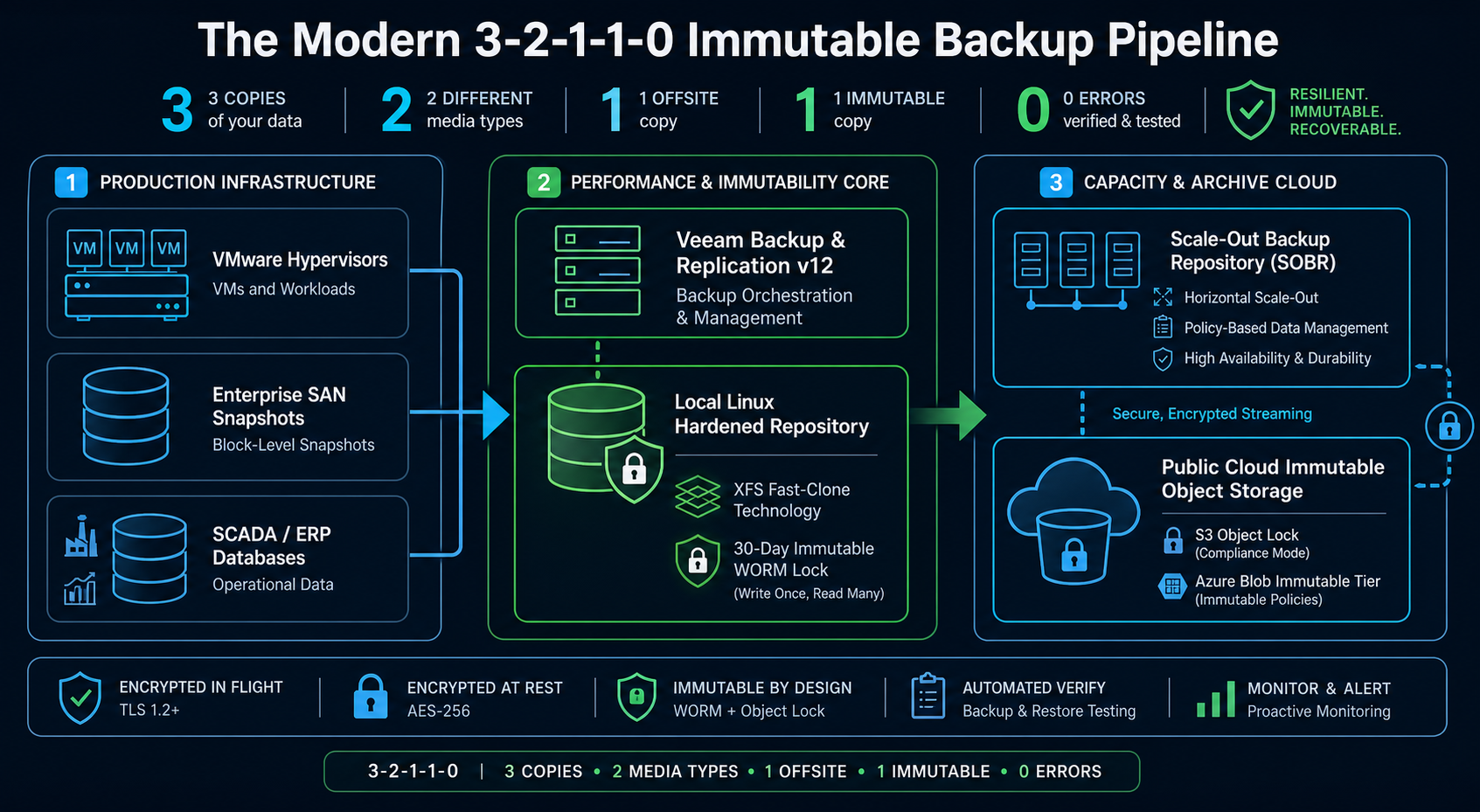
2. The Four-Stage Modernization Playbook
Executing a complete backup architecture replacement across 12 live manufacturing sites requires zero disruption to active manufacturing execution systems (MES):
- Stage 1: Hardware Deployment & Linux Repository Hardening (Days 1–25):
- Stage 2: Veeam v12 Core & Storage Snapshot Integration (Days 26–50):
- Stage 3: Scale-Out Backup Repository (SOBR) & Cloud Immutability (Days 51–75):
- Stage 4: Automated Verification (SureBackup) & DR Drills (Days 76–90):
3. Deep-Dive Automation: Scale-Out Storage Tiering & Immutable Policy
The technical implementation is governed by a Scale-Out Backup Repository (SOBR) lifecycle engine that manages data placement, deduplication, and retention immutability:
Veeam Sobr Immutable Tiering
Trigger: Scheduled Backup Job Execution (15-Minute CDP / Nightly Synthetic Full)
Processing Sequence:
  - Step 1 [Snapshot Integration]: Query SAN API to create storage-level hardware snapshot; isolate modified blocks.
  - Step 2 [Local Performance Ingestion]: Stream deduplicated data blocks to Linux Hardened Repository (XFS Reflink).
      * Storage Directive: Apply immutable flag (chattr +i) at OS level for 14 continuous days. Fast-clone creates space-less synthetic fulls.
  - Step 3 [Capacity Tier Streaming]: SOBR Copy Policy instantly streams identical backup blocks to Cloud Object Storage.
      * Object Lock Directive: Apply S3 Object Lock / Azure Immutable Blob policy in Compliance Mode for 30 days.
  - Step 4 [Verification Automation - SureBackup]:
      * Spin up isolated non-routable virtual sandbox environment.
      * Boot target VM directly from backup image via vPower NFS (Instant Recovery).
      * Execute automated test script: Verify OS heartbeat -> Verify Network Ping -> Run SQL query integrity script.
      * If Passed: Generate cryptographic attestation log and power down sandbox. If Failed: Raise P1 alert in Freshservice ITOM.
“An organization does not own what it cannot recover. Immutability transforms your data protection from a passive target into an unbreachable foundation for rapid operational recovery.”
4. Business Impact & Disaster Recovery Readiness
The deployment of the modernized Veeam immutable cloud architecture delivered comprehensive operational and business security:
- Guaranteed Ransomware Resilience: Backup images are cryptographically protected against modification or deletion, eliminating extortion leverage from ransomware actors.
- Reclaimed WAN Bandwidth: Block-level tracking and synthetic fulls reduced daily backup network payloads by 78%, eliminating replication contention on plant manufacturing circuits.
- Drastic Reduction in Cyber Insurance Premiums: Demonstrating verified 3-2-1-1-0 compliance and automated SureBackup testing reports qualified the enterprise for a 30% reduction in annual cyber insurance liability deductibles.
Enterprise Backup Modernization Checklist
- Eliminate Windows-joined backup repositories; migrate local storage to Linux Hardened Repositories with XFS file-level immutability.
- Enforce public cloud object storage with Object Lock in Compliance Mode for all secondary offsite copies.
- Decouple all backup administrative credentials completely from production Active Directory domains.
- Implement automated, sandboxed restore testing (SureBackup) to verify database consistency rather than relying solely on job-completion emails.