Identity is the modern security perimeter, yet in scaling enterprises with mergers, acquisitions, and remote workforces, identity is often the most neglected vector. Following four rapid acquisitions, a 3,200-employee professional services firm found itself managing fragmented active directories, 42 standing Global Administrator accounts, unmanaged legacy authentication protocols, and zero centralized Conditional Access governance—leaving the company severely exposed to credential spraying, token theft, and cross-tenant lateral movement.
This comprehensive case study examines the architectural overhaul that consolidated disparate identity silos into a unified Microsoft Entra ID Zero Trust ecosystem. By deploying granular Conditional Access policies, enforcing phishing-resistant FIDO2/certificate-based authentication, implementing Privileged Identity Management (PIM) with just-in-time elevation, and establishing cross-tenant access governance, the organization neutralized credential exposure while simplifying day-one access for distributed personnel.
Identity Attack Surface Reduction
Deprecated legacy authentication (POP3, IMAP, Basic Auth) and blocked automated credential spraying attempts.
Zero Standing Privilege (ZSP)
Migrated 42 permanent Global Admins to zero permanent privileges using Entra ID Privileged Identity Management (PIM).
FIDO2 / Phishing-Resistant MFA
Enforced hardware token and Microsoft Authenticator number-matching policies across all corporate endpoints.
Annual Audit & Cyber Insurance Savings
Achieved full SOC 2 Type II and ISO 27001 identity compliance while qualifying for tier-1 cyber insurance risk brackets.
1. The Legacy Anatomy: Acquisition Sprawl and Standing Privilege Exposure
Before the architectural reset, the enterprise suffered from severe structural identity drift caused by rapid business acquisitions and uncoordinated cloud deployments:
- The Standing Privilege Exposure: Over 40 engineers and IT support technicians possessed permanent 24/7 Global Administrator roles with single-factor passwords, meaning a single phishing breach could hand an attacker the keys to the entire tenant.
- Legacy Protocol Backdoors: Legacy basic authentication remained active on mailboxes to support older internal scripts, leaving tenant endpoints vulnerable to password spray attacks that bypassed standard MFA.
- Cross-Tenant Blindspots: Acquired subsidiary tenants maintained unmonitored external trust relationships, allowing unvetted guest accounts and personal mailboxes unmonitored access to sensitive internal SharePoint and Azure subscriptions.
| Identity Vector | Legacy Sprawl Baseline (Compromised) | Zero Trust Entra ID Architecture (Target State) | Security & Business Impact |
|---|---|---|---|
| Privilege Elevation | 42 Standing 24/7 Global Admins; unlogged modifications. | Entra ID PIM (Just-In-Time, Max 4-Hour Elevation, Ticket ID Approval). | Zero standing attack surface; full audit trail of privileged session activity. |
| Authentication Standard | SMS / Voice Call MFA; Legacy Basic Auth enabled across endpoints. | Phishing-Resistant FIDO2 / Number Matching; Basic Auth blocked at tenant boundary. | Neutralizes Adversary-in-the-Middle (AiTM) and credential replay attacks. |
| Access Decisions | Static perimeter firewalls; once on VPN, user access is unconstrained. | Continuous Real-Time Conditional Access (User Risk, Device Health, IP Location). | Real-time session revocation the moment device compliance or user risk spikes. |
| External Guest Governance | Ad-hoc unmanaged invites; orphan guest accounts persist forever. | Entra ID Entitlement Management with automated 90-day Access Reviews. | Eliminates lingering vendor access; automated offboarding of external parties. |
| Workload & Service Identities | Hardcoded client secrets in application config files and code repos. | Azure Managed Identities & Workload Identity Federation with short-lived tokens. | Eliminates credential leakage in source code; automated cryptographic rotation. |
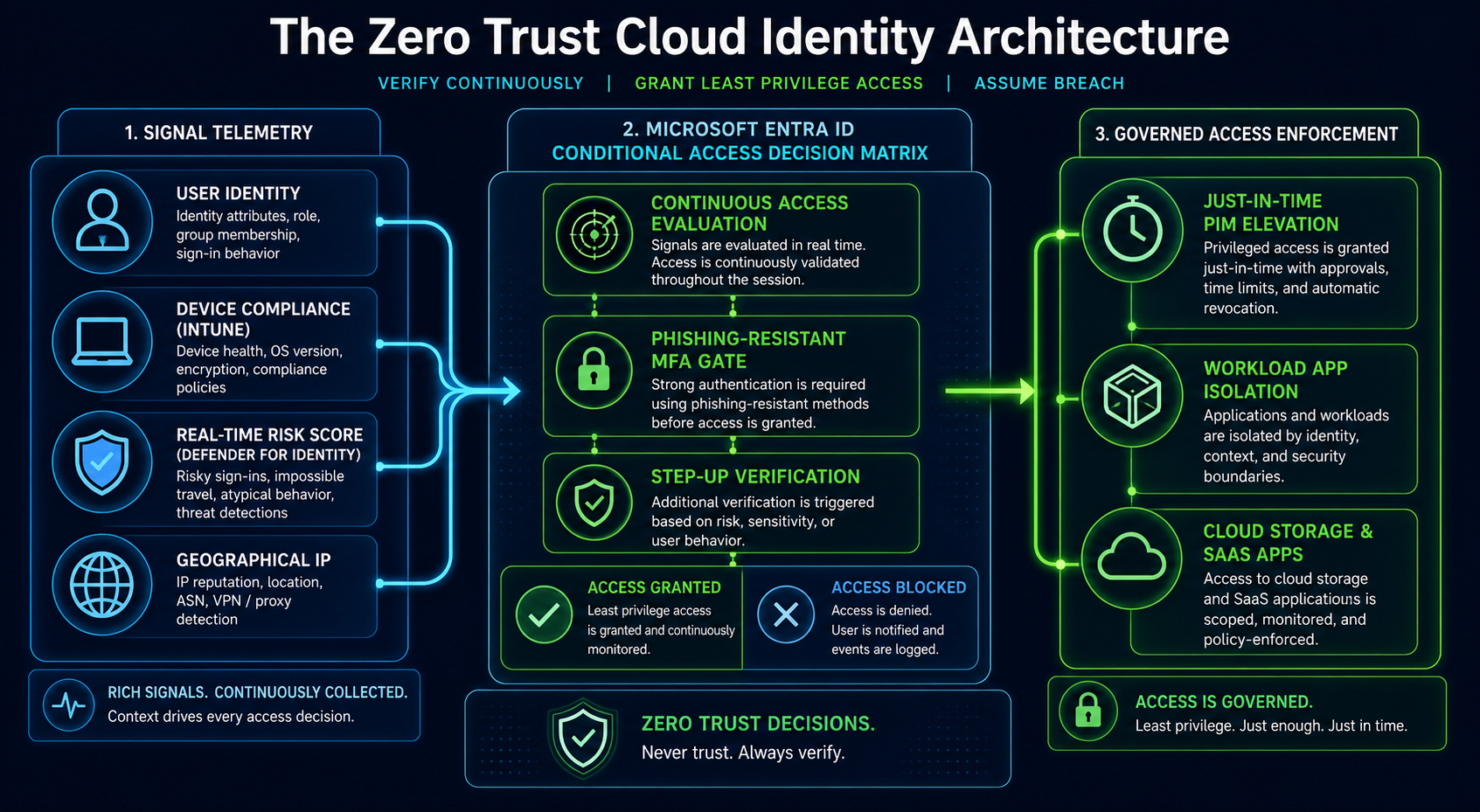
2. The 90-Day Zero Trust Identity Migration Playbook
Transitioning a live, revenue-generating enterprise to strict Zero Trust without locking out executives or disrupting operational workflows requires a disciplined, phased rollout:
- Phase 1: Signal Telemetry, Device Registration & Legacy Auth Teardown (Days 1–30):
- Phase 2: Phishing-Resistant MFA & Conditional Access Enforcement (Days 31–60):
- Phase 3: Privileged Identity Management (PIM) & Entitlement Governance (Days 61–90):
3. Deep-Dive Security Architecture: Conditional Access Policy Matrix
The heart of the identity perimeter is a tiered Conditional Access policy suite designed according to the principle of continuous verification:
Conditional Access Matrix
Policy Tier 1: Emergency & Baseline Hardening
- Target: All Users | All Cloud Apps
- Condition: Sign-in Protocol = Legacy Authentication (POP3, IMAP, SMTP, ActiveSync)
- Action: Block Access Immediately (No Exceptions).

Policy Tier 2: Administrative Privilege Elevation (PIM JIT Gate)
- Target: Privileged Roles (Global Admin, Security Admin, Intune Admin, Exchange Admin)
- Condition: Elevation Request Triggered in Entra PIM
- Action: Require Phishing-Resistant MFA (FIDO2) + IT Helpdesk Ticket ID Validation + Maximum Duration: 4 Hours.

Policy Tier 3: High-Risk User & Session Interception
- Target: All Corporate Users
- Condition: Entra ID Protection User Risk Level = High OR Session Risk Level = High
- Action: Block Session + Terminate All Active Refresh Tokens (Continuous Access Evaluation).

Policy Tier 4: External Guest & Multi-Tenant Access
- Target: B2B External Guests / Acquired Subsidiary Accounts
- Condition: Accessing Internal Financial Systems or CMDB
- Action: Require Compliant Managed Device + Mandatory Terms of Use Re-Acceptance every 30 Days.
“In a cloud-first enterprise, perimeter walls do not exist. Your identity plane is your firewall, your access policy is your segmentation, and Just-In-Time privilege is your strongest line of defense.”
4. The Operational & Strategic Payoff
Following deployment, the enterprise achieved complete identity resilience and streamlined operational governance:
- Zero Account Takeover Incidents: Successfully repelled daily credential-stuffing campaigns and automated token-replay attacks with zero compromised user sessions over four continuous quarters.
- Accelerated M&A Onboarding: Newly acquired corporate divisions are now integrated into the central identity governance framework within days using B2B direct connect and cross-tenant synchronization instead of multi-month forest migrations.
- Complete Audit Readiness: Real-time PIM logs and automated access review attestations reduced compliance preparation time for external SOC 2 and ISO audits from 3 weeks of manual data compilation down to a single automated report export.
Zero Trust Identity Checklist
- Run an immediate audit to eliminate standing 24/7 Global Administrator roles; migrate all administrators to Entra ID PIM.
- Block legacy basic authentication protocols tenant-wide across all user and service accounts.
- Enforce phishing-resistant multi-factor authentication (FIDO2 or Number Matching) for all privileged accounts.
- Implement continuous access evaluation (CAE) to revoke active tokens immediately upon user termination or risk level elevation.