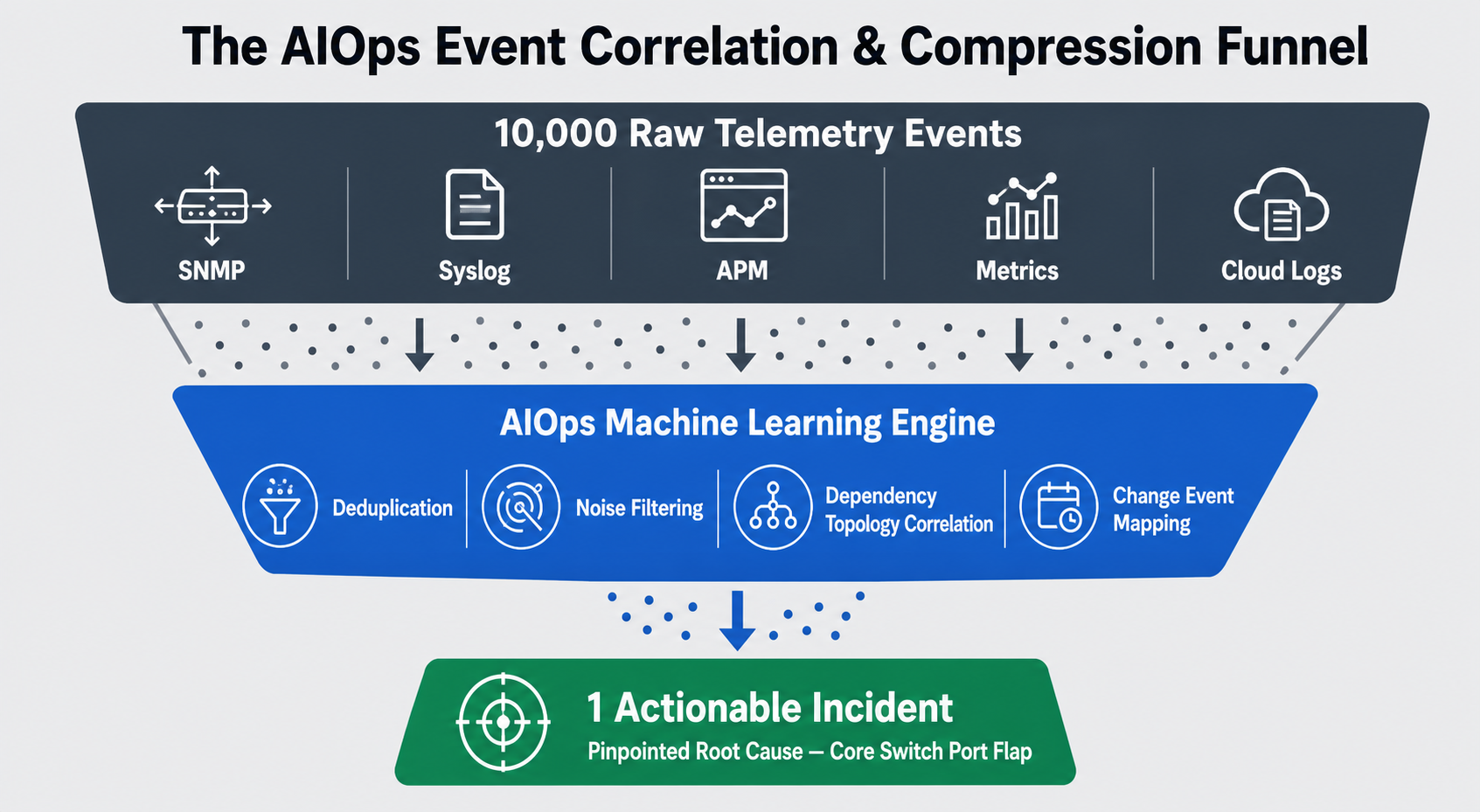
When an enterprise network switch fails, it does not generate one clean alert; it triggers three thousand downstream notifications: server unreachable alarms, database timeout warnings, application health check failures, and user connectivity tickets. Sifting through this avalanche of noise manually paralyzes the Network Operations Center.
Artificial Intelligence for IT Operations (AIOps) is not about replacing engineers—it is about restoring their visibility. By utilizing unsupervised machine learning, dynamic baseline profiling, and topology-aware event correlation, AIOps consolidates thousands of disconnected telemetry events into a single actionable incident, pinpointing the true root-cause dependency within seconds.
Alert Compression Ratio
Proportion of raw telemetry events consolidated into single correlated incident tickets.
Root-Cause Localization
Average time required for AIOps engine to identify the primary failure node.
Static Threshold Alerts
Elimination of rigid CPU/RAM alarm thresholds prone to false-positive alarms.
1. Traditional Alerting vs. AIOps Event Correlation
| Telemetry Dimension | Legacy Threshold Monitoring (Fails) | Modern AIOps Architecture (Advanced) | Operational Benefit |
|---|---|---|---|
| Baseline Detection | Static thresholds (e.g., Alert if CPU > 90% for 5 mins). | Dynamic time-series baselining factoring in seasonal workload shifts. | Eliminates false-positive alarms during scheduled batch processing. |
| Event Correlation | Disconnected alert storms firing across 50 separate tools. | Topology-aware graph analysis grouping all events by dependency path. | Consolidates thousands of alarms into one master incident root cause. |
| Diagnostic Context | Raw error string forwarded without historical context. | Automatically appends recent code deployments, config changes, and metrics. | Engineers bypass manual triage and begin immediate restoration. |
| Incident Evolution | Reactive intervention only after users complain. | Predictive early-warning indicators detecting degradation trends. | Remediates failure conditions before business services go down. |
“AIOps is useless if it simply gives you a smarter dashboard of alerts to ignore. True operational intelligence compresses noise into a single definitive engineering action.”
2. The Mathematical Foundations of Event Correlation
Modern AIOps platforms utilize three core mathematical and algorithmic techniques to process high-velocity telemetry:
- Temporal Proximity Clustering: Grouping discrete alert events occurring within a defined rolling time window across related infrastructure tiers.
- Dependency Graph Analysis: Mapping real-time CMDB and network topology graphs to identify which upstream infrastructure component caused downstream service failures.
- Change-Event Correlation: Intersecting telemetry spikes with CI/CD deployment pipelines, patch cycles, and administrative configuration updates to isolate human-induced failures.
AIOps Implementation Strategy
- Integrate all monitoring endpoints (RMM, APM, CloudWatch, Syslog) into a single ingestion broker (e.g., Azure Monitor / Datadog / Dynatrace).
- Map infrastructure dependencies in your CMDB to enable topology-aware graph correlation.
- Deprecate isolated tool-based email notifications; route all alerts exclusively through the correlation pipeline.