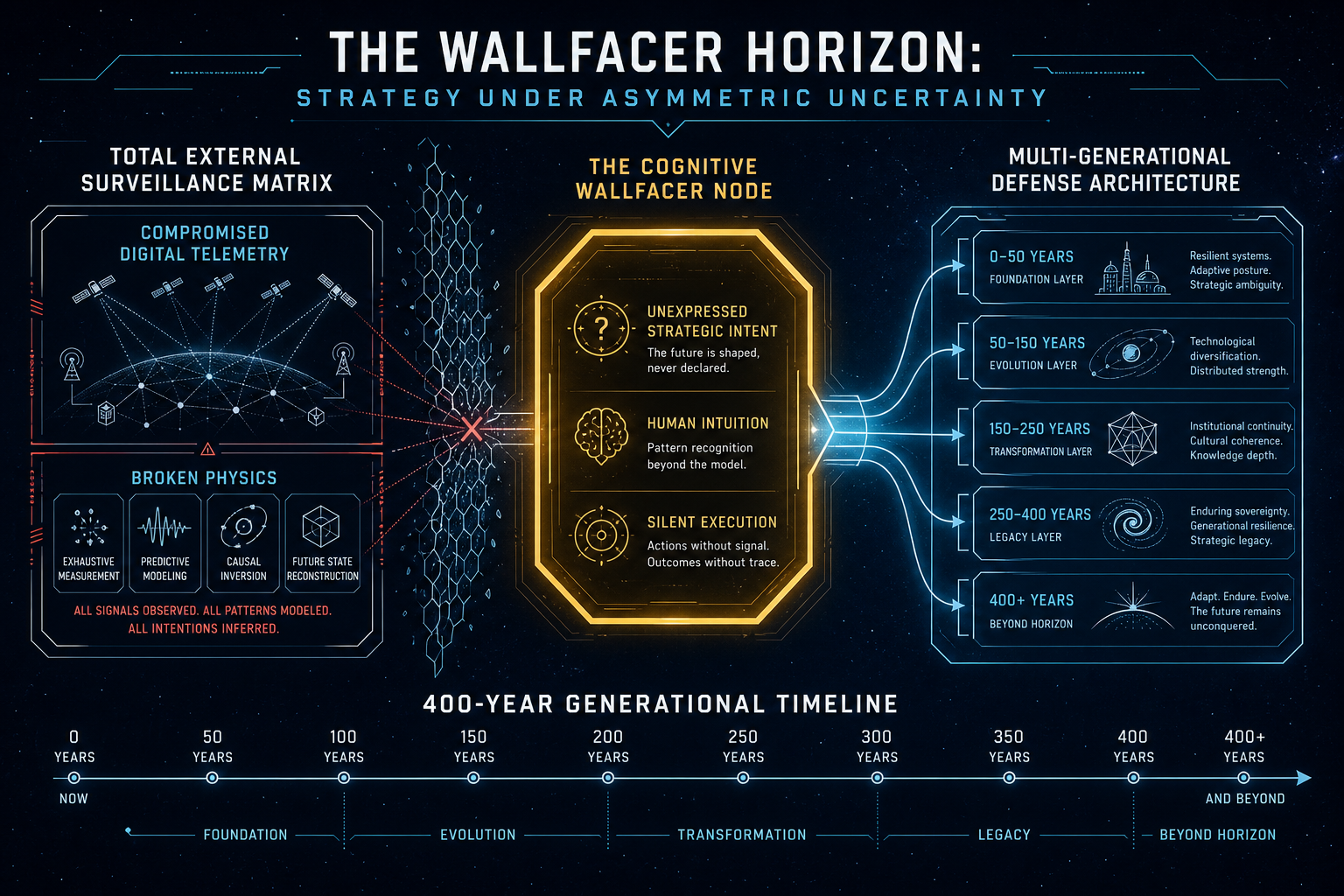
Most corporate and political leadership models operate on four-quarter cycles or five-year strategic roadmaps. In *3 Body Problem*, humanity faces a crisis that shatters conventional planning: an incoming extraterrestrial fleet that will arrive four centuries in the future, preceded by invisible microscopic supercomputers (Sophons) that sabotage fundamental scientific research and monitor all digital and verbal communication.
The narrative serves as an extreme stress test for long-horizon decision-making. When facing an adversary with total asymmetric surveillance and superior technological capability, standard transparency, consensus roadmaps, and short-term ROI metrics collapse. Leadership under radical uncertainty demands unprecedented strategic architectures: the Wallfacer Project (compartmentalized human intuition immune to surveillance), multi-generational resource allocation, and maintaining civilizational hope across centuries.
Strategic Planning Horizon
Designing, funding, and executing defense architectures that span generations beyond the founders' lifespans.
Information Asymmetry
Operating in an environment where all external telemetry, communication, and digital records are fully compromised.
Cognitive Compartmentalization
Entrusting total strategic execution to singular minds without requiring consensus or public explanation.
1. Governance Paradigms Under Radical Uncertainty
When standard operating rules and empirical scientific assumptions fail, leaders must pivot to radically different governance frameworks:
| Crisis Dimension | Conventional Management Response (Fails) | The Multi-Generational Strategic Pivot (Resilient) | Strategic Principle |
|---|---|---|---|
| Total Intelligence Breach (Sophons) | Invest billions in traditional cryptographic patches that are already obsolete. | Shift strategic planning inside isolated human minds (The Wallfacer Project). | In full telemetry exposure, human cognitive opacity becomes the only secure enclave. |
| 400-Year Timeline Horizon | Postpone capital investment; focus only on immediate electoral/fiscal quarters. | Establish irrevocable multi-century resource trusts and industrial foundations. | True civilizational resilience requires decoupling long-term survival from short-term incentives. |
| Scientific Sabotage (Broken Physics) | Deny anomalies and force outdated theoretical models onto broken data. | Acknowledge fundamental disruption; pivot toward applied engineering and asymmetric defense. | When foundational axioms collapse, dogma is fatal; agility and realism must prevail. |
| Public Despair & Defeatism | Enforce mandatory performative optimism and suppress difficult truths. | Balance sober threat realism with concrete societal missions and shared purpose. | Sustained resilience requires confronting brutal reality without losing the will to endure. |
“In the face of an existential threat that will arrive long after we are gone, our true test is not whether we see the finish line, but whether we have the discipline to lay the foundation stones for those who will fight the battle centuries from now.”
2. What Uncertainty Does to People and Institutions
The series becomes most compelling when its cosmic scale remains attached to intimate choices. Ye Wenjie’s decision grows from political violence, grief, disillusionment, and a catastrophic loss of faith in humanity. Jin Cheng’s scientific curiosity collides with loyalty. Saul is handed significance he neither understands nor wants. Wade treats survival as permission to become brutally instrumental.
The sophons create more than a scientific obstacle. They create an epistemic crisis: evidence can be manipulated, observation cannot be trusted, and institutions must coordinate across generations without knowing whether their plans are visible to the adversary. The Wallfacer concept responds by placing strategy inside private thought, but it also concentrates power in ways that should remain unsettling.
The adaptation compresses complex ideas and sometimes uses exposition where ambiguity would be stronger. Yet it succeeds at making scale emotionally legible. The central tension is not simply humanity versus an approaching civilisation; it is whether a fragmented species can act together when fear changes what everyone believes about everyone else.
The question beneath the spectacle
What forms of trust are possible when secrecy is strategically necessary and every institution knows that its information may be compromised?